Part of: Crisis Leadership
Board Decisions During a Crisis Must Hold
In this dispatch
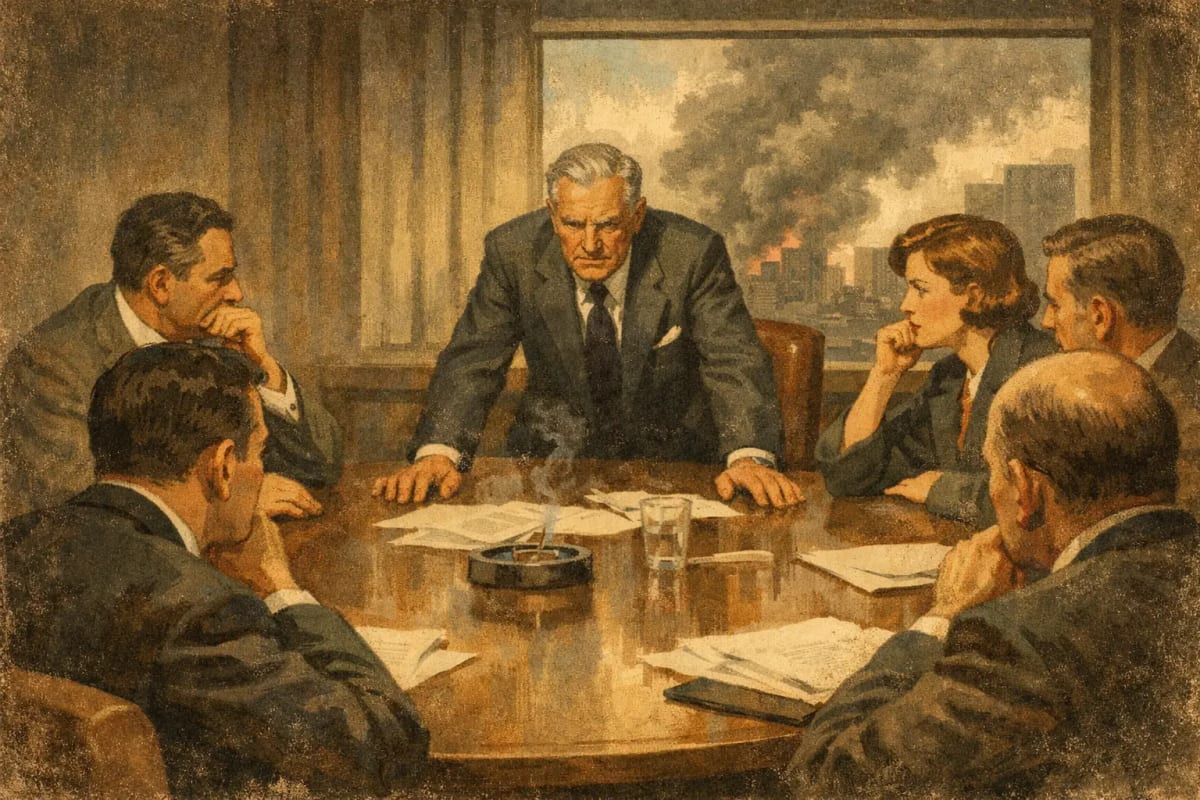
A crisis does not merely test whether a board can meet quickly. It tests whether its members can exercise power without surrendering judgment. Board decisions during a crisis are made under incomplete facts, compressed time, conflicting duties, and often a public demand for certainty that no responsible leader can honestly provide.
That is why the first failure is usually not a bad vote. It is a board that has not decided who has authority, what standard governs the decision, or what record must remain after the pressure passes. The crisis is the audit. A board that treats governance as a calendar event will discover too late that its procedures were built for peace.
Board Decisions During a Crisis Need a Command Structure
The board governs. Management executes. In ordinary periods, that division can tolerate some ambiguity. In a true emergency, ambiguity becomes a source of delay, duplication, and evasion.
Before considering a particular action, the board chair and chief executive should establish the operating posture. Is this a management emergency requiring heightened reporting? Is it a board-level event involving solvency, a major transaction, executive succession, legal exposure, institutional legitimacy, or a threat to the organization’s mission? The answer determines who may act, who must be consulted, and which decisions require formal board approval.
Do not confuse access with authority. A director who can reach the CEO at midnight does not automatically have authority to direct management. Nor does an engaged board need to take over operations to fulfill its duty. The board’s task is to set boundaries, demand evidence, approve consequential commitments, and hold management accountable for execution.
The chair carries particular responsibility. Someone must control the agenda, separate fact from rumor, prevent side conversations from becoming shadow governance, and state what has actually been decided. A crisis board call without a clear chair is often a contest between the loudest voice and the most anxious one.
Authority should be written down in plain language. Specify the immediate decision rights, spending limits, reporting cadence, required approvals, and trigger points for reconvening. This is not bureaucracy. It is command discipline.
Speed Is Necessary. Panic Is Not.
Many boards overcorrect in a crisis. Having been criticized for slow deliberation in the past, they decide that speed itself is evidence of leadership. It is not. Speed is useful only when it shortens the distance between verified facts and necessary action.
The board should ask three questions before approving any major move: What do we know? What are we assuming? What must be true for this decision to work? These questions expose the false certainty that produces costly errors.
Consider a liquidity event. Management may recommend immediate layoffs, asset sales, or a high-cost financing package. Each may be defensible. Each may also damage the institution’s ability to recover. The board must distinguish between preserving cash for thirty days and preserving the enterprise for three years. A decision that protects the next payroll while destroying the company’s core capability may still be the wrong decision.
The same discipline applies to public controversy. A rapid statement can calm a market, a workforce, or a community. It can also create legal exposure, contradict later facts, or commit the organization to a standard it cannot sustain. Silence is not always cowardice. But silence without a stated reason, a time limit, and a next decision point is usually drift.
There is no universal rule that says boards should move fast or wait. It depends on the nature of the threat. In a safety event, delay can cost lives. In an acquisition dispute fueled by rumor, a rushed response can hand advantage to an adversary. The governing standard is not pace. It is proportion.
Build the Decision Record Before the Outcome Is Known
A board minutes document that merely records a resolution is not enough. It may satisfy a formal requirement, but it does not show how the board discharged its duty when the matter becomes contested months later.
For every consequential crisis decision, create a decision record. It should identify the decision owner, the facts reviewed, material uncertainties, alternatives considered, counsel or outside expertise consulted, risks accepted, conditions attached, and the date for reassessment. It should also state the reasoning in language a serious outsider could understand.
The purpose is not self-protection alone. A clear record improves the decision itself. When directors know they must articulate why they chose one course over another, weak claims lose force. Vague assurances become visible. Convenient assumptions must be named.
A disciplined record also protects dissent. Directors should not be pressured to manufacture unanimity when a reasonable disagreement exists. Honest dissent can surface risks the majority has discounted. At the same time, dissent is not a license for theater or sabotage. Once a lawful decision is made, directors owe the institution candor in the room and discipline outside it, subject to their continuing fiduciary duties.
Abraham Lincoln did not require harmony among every member of his cabinet before acting. He required the capacity to hear competing judgment, decide, and bear responsibility for the result. Boards need the same moral posture. Consensus is useful when it is earned. It is dangerous when it is staged.
Treat Legitimacy as an Operating Asset
A board can survive an unpopular decision. It cannot easily survive a decision that appears arbitrary, self-protective, or detached from the institution’s stated obligations.
Legitimacy is not public relations. It is the accumulated evidence that power is held in trust. Employees, lenders, customers, regulators, donors, shareholders, and communities may not agree with a board’s choice. They will still judge whether the process showed competence, fairness, and fidelity to duty.
This is especially acute when directors face conflicts of interest. In a crisis, conflicts do not become less important because time is short. They become more dangerous. Recusal, independent review, special committees, and outside counsel may slow the process. That cost can be justified when the alternative is a decision permanently weakened by the appearance or reality of divided loyalty.
The board should also test the human consequence of its decision. A workforce reduction may be financially necessary. The manner of execution remains a choice. So do severance terms, communications, executive compensation, customer obligations, and the treatment of people who carried the institution through earlier difficulty. Hard calls are not made honorable by calling them unavoidable. Honor lies in the standard applied when avoidance is no longer possible.
Establish Triggers, Not Just Meetings
A crisis board should not operate by vague promises to “stay close.” It should establish triggers that require action. If liquidity falls below an agreed threshold, if a regulator issues a notice, if a key executive becomes unavailable, if a cyber event crosses a defined severity level, or if a public allegation receives credible evidence, the board already knows what happens next.
Triggers reduce hesitation because they settle procedural questions before emotion takes command. They also prevent overreaction. Not every negative headline requires a special meeting. Not every missed forecast requires a restructuring committee. The threshold should match the stakes.
This is where scenario practice earns its keep. Boards should rehearse the questions they would face under pressure: Who speaks? What information is privileged? Which contracts can be signed? What happens if the CEO is conflicted, incapacitated, or wrong? Which stakeholder obligation cannot be traded away? A board that has never practiced these questions is not prepared simply because its directors are accomplished.
Make the Hard Call Before Pressure Makes It
The central work of crisis governance happens before the emergency. It happens when directors establish standards for leverage, succession, executive conduct, risk concentration, disclosure, and institutional purpose while the room is still calm.
When the moment comes, do not ask whether the decision will be painless. Ask whether it is lawful, necessary, proportionate, consistent with the institution’s obligations, and fit to be defended in a record that survives you. Then assign authority, decide, document, and return to the facts.
The board’s duty is not to look composed while the institution deteriorates. Its duty is to preserve the conditions under which the institution can remain worthy of trust. Make the hard call before pressure makes it for you.
When a Corporate Governance Crisis Becomes a Test
A corporate governance crisis is not solved by messaging. It is settled through accountable decisions, records, and standards that hold under pressure.
How Institutions Lose Legitimacy Under Pressure
How institutions lose legitimacy when leaders evade standards, hide decisions, and mistake legal authority for public trust under pressure in crisis.