Leader Lab · Crisis-era leadership
The facts are incomplete.
The call is still yours.
Work through the decision in front of you. Establish what is known, weigh the cost of each option, and leave with a brief that names the call, the next action, and when to reconsider.
A first call. New information. A brief to keep.
Free fictional rehearsal · no account required.
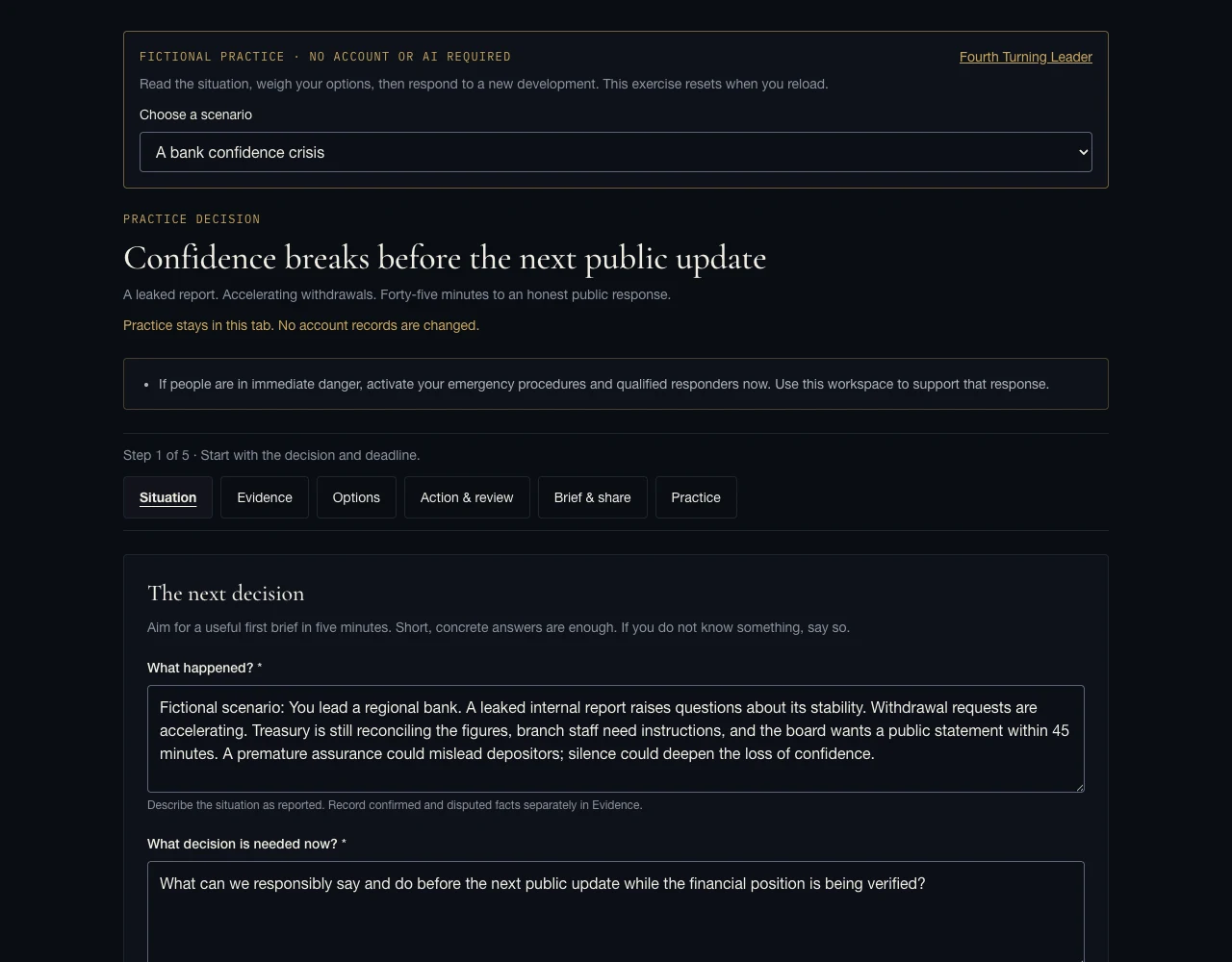
Fictional bank confidence crisis
45 minutes.
Trust is on the line.
A leaked report is spreading. Withdrawals are reportedly accelerating. Treasury is still reconciling the figures. You have 45 minutes before the bank’s public statement.
- Confirmed
- An internal report is circulating publicly.
- Reported
- Withdrawals are above normal; totals are unreconciled.
- Your task
- Decide what the bank should tell depositors before the deadline.
A fictional scenario showing the kind of work you build.
The complete Leader Lab
For the decision you carry.
And the ones after it.
A self-guided online workspace for leadership when trust, authority, and continuity are at stake.
- 01Work the decision
- Bring your own crisis decisions into a workspace for evidence, competing options, accountable actions, and a decision brief.
- 02Build the code behind it
- Honor, Culture, and Command Labs for your commitments, organizational standards, and institutional continuity.
- 03Return and follow through
- Saved cases, review prompts, an AI companion, Field Notes, and document exports.
Read a finished example
From a difficult situation
to a decision you can explain.
A fictional bank confidence crisis: depositors need answers while the figures are still being verified. Read one possible response, the code behind it, and the leadership pattern to watch.
Decision memo
Illustrative example- The decision
- A leaked report is spreading. Withdrawals are reportedly accelerating. Treasury is still reconciling the figures. You have 45 minutes before the bank’s public statement. What can we responsibly tell depositors now?
- People at risk
- Depositors need access to savings. Local employers need to meet payroll. Employees need instructions they can trust.
- Evidence
- Confirmed: an internal report is circulating publicly. Reported: withdrawals are above normal, with totals still unreconciled. Unknown: the current financial position and whether the report is current.
- Options
- Offer broad reassurance now; wait for reconciled figures; or acknowledge the uncertainty with verified facts and a specific next update.
- The trade
- Candor may accelerate withdrawals. Waiting leaves depositors without guidance. Unsupported reassurance could destroy trust if the figures contradict it.
- Code check
- The Line rules out unsupported assurances. The Restraint protects staff from repeating claims they cannot verify.
- The call
- Acknowledge the uncertainty. State only what has been verified, name who is checking the figures, and commit to a timed update.
- Owner and review
- Treasury lead: verify figures before the statement. Communications lead: give branches the approved wording. CEO: issue the statement within 45 minutes and review again in one hour, or sooner if the evidence changes.
Your own work begins with the facts of your decision. The Lab provides prompts, saved drafts, and exports; you supply the judgment.
One practice. Three scales.
Build the commitments
behind the next call.
Start with a current decision in the crisis workspace. Use the three labs to develop the code, standards, and continuity that future decisions depend on.
You
The Honor Lab
Write the commitments that guide your decisions. Watch where your default under pressure can fail you, and return to the record to see whether your code held.
Your organization
The Culture Lab
Define the standards your organization keeps when pressure rises. Work through contested decisions, invite dissent, and record exceptions in the Culture Registry.
Your institution
The Command Lab
Work through questions of authority, legitimacy, and continuity. Name successors and commitments, and deliberately publish an institutional record when you are ready.
Explore the six Honor Lab tools
Mode Finder
A profile of the leadership patterns your answers suggest under pressure.
Shadow Audit
A watchlist of where a strength can become a liability.
Honor Code Builder
Five written commitments: your line, restraint, test, growing edge, and transmission.
Decision Room
A memo that records the options, the cost, and the call you can explain.
Endurance Ledger
A review of how your code holds over time. Five entries open a pattern report.
Transmission Plan
Named successors and the judgment you want them to carry forward.
Work at your own pace. You can work on decisions and export individual documents before completing your full Code Packet.
Return to the decision, not a blank page.
Your saved cases, owned actions, and outcome reviews give you a place to resume. The Endurance Ledger and Midnight Test support ongoing reflection; Field Notes and the AI companion help you examine the reasoning.
Try the method. Then use it.
What changes when you open the Lab?
| Your work | Free rehearsal | Leader Lab · $495 once |
|---|---|---|
| The situation | A fictional crisis with a new development | Your own decisions and evidence |
| The takeaway | Your rehearsal brief, available to download | Decision briefs, codes, and the documents you build and export |
| Follow-through | Try the steps without an account | Save cases, return to owned actions, and review outcomes |
| The wider practice | A sample of the crisis workspace | All three labs, Field Notes, an AI companion, and a printed Field Guide |
Before you bring a real decision.
Personal drafts are private within the Lab by default. Institutional publishing is deliberate. Ask Chris sends your messages and relevant saved work to Delphi; requested AI analysis uses Anthropic. Use information you are authorized to share. Read how your work is processed →
See the full crisis workspace
Start with one decision