Part of: Crisis Leadership
How Institutions Lose Legitimacy Under Pressure
In this dispatch
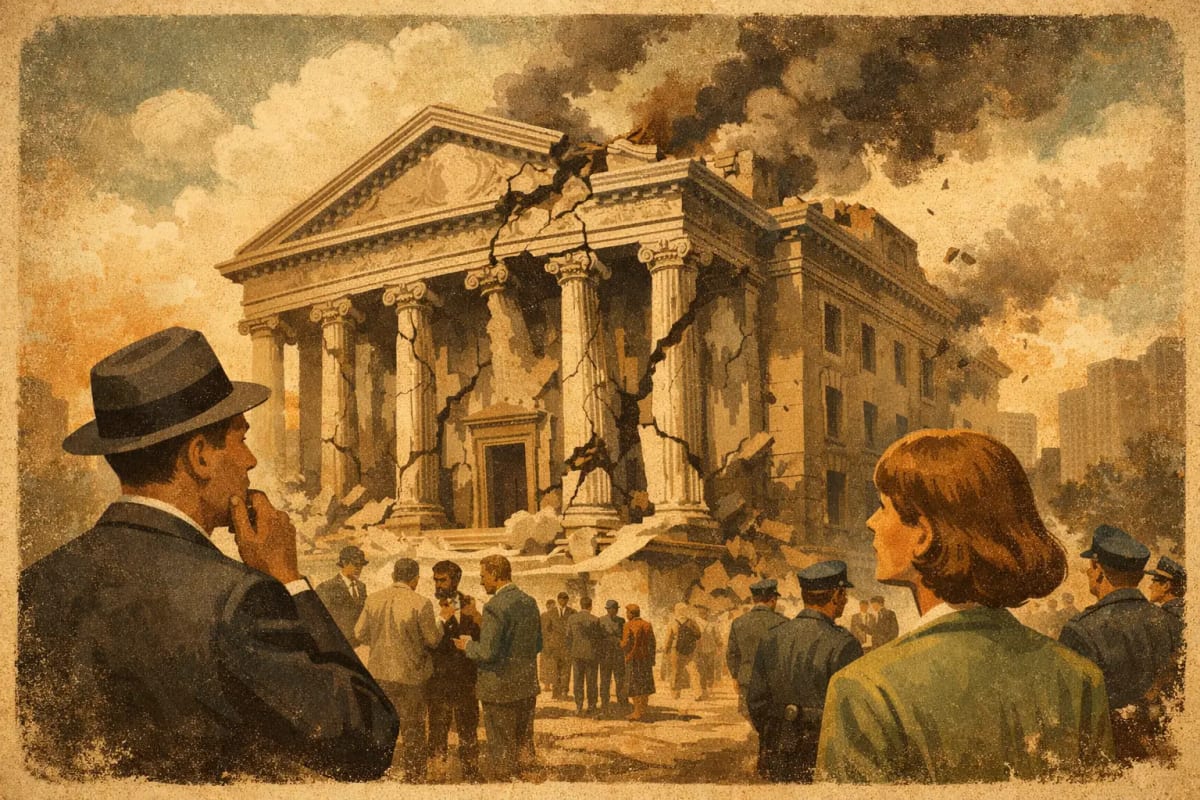
A board may retain every formal power it had last quarter. A university may keep its charter. A bank may remain solvent. Yet employees stop believing the rules apply evenly, customers assume explanations are evasions, and citizens or members begin looking elsewhere for authority. This is how institutions lose legitimacy: not only through collapse, but through the slow public recognition that power is no longer being held in trust.
Legitimacy is not popularity. A leader can make an unpopular decision and preserve legitimacy if the decision is within a known standard, the reasons are stated plainly, and the burden is borne honestly. Conversely, an institution can enjoy strong approval for a season while hollowing out the conditions that make obedience, loyalty, and sacrifice voluntary.
For executives, this distinction matters because operational authority can survive after moral authority has been spent. The crisis is the audit. When pressure comes, stakeholders do not merely ask whether the institution can act. They ask whether it deserves to.
Legitimacy Is Earned Through Constrained Power
An institution is legitimate when people believe its authority is bounded by a purpose, governed by rules, and exercised by people who accept accountability for their choices. They do not need to agree with every outcome. They need reason to believe the process is real and the standards will hold when a powerful person is inconvenienced.
That belief rests on a practical chain: stated purpose, consistent standards, competent execution, visible accountability, and records that can survive scrutiny. Remove one link and the institution becomes more vulnerable. Remove several and its official powers begin to look like mere force, procedure, or position.
This is why legality is necessary but insufficient. A decision can be lawful, financially rational, and still destructive to legitimacy. If leaders use technical compliance to avoid the evident duty of the situation, people will see the gap. They may not use the language of political philosophy. They will say the institution is rigged, hypocritical, cowardly, or no longer serious.
How Institutions Lose Legitimacy: The Four Failures
Institutional decline rarely begins with a single scandal. More often, it begins with repeated small evasions that teach people the actual rules.
Standards become selective
Every institution has formal standards and operational standards. The formal standards appear in policies, codes, contracts, and public statements. Operational standards are revealed by what happens when a top producer, donor, executive, faculty star, lender, or politically connected figure breaks those rules.
The decisive question is not whether exceptions ever exist. Serious institutions require judgment. The question is whether exceptions are principled, documented, and available to everyone under the same conditions. An undocumented exception for the powerful is not flexibility. It is a lesson in unequal obligation.
Once people learn that status determines enforcement, they stop treating the institution's values as standards. They treat them as public relations. Good people then face a bleak choice: conform to the hidden system, remain silent, or leave.
Leaders substitute messaging for explanation
Under pressure, leaders often overmanage language. They issue statements that say little, refer questions to process, and bury responsibility in committees or legal phrasing. Some restraint is appropriate. Personnel matters, litigation, national security, and confidentiality impose real limits.
But silence has a cost when it becomes a substitute for moral clarity. Stakeholders can tolerate limits on disclosure better than they can tolerate obvious evasion. A credible leader can say: Here is what we know. Here is what we cannot disclose. Here is the standard governing our action. Here is who owns the next decision and when we will report back.
That is not a public-relations technique. It is the discipline of treating adults as citizens of the institution rather than an audience to be managed.
Procedure replaces judgment
Institutions need process because power without process becomes arbitrary. Yet process can become a shield for leaders unwilling to make the hard call before pressure makes it. The organization announces a review, commissions an assessment, forms a task force, and delays the decision until the moment for responsible action has passed.
The trade-off is real. Moving too quickly can create error, unfairness, and unnecessary conflict. But endless proceduralism produces its own injustice. It leaves obvious harms in place, distributes responsibility so widely that no one is accountable, and signals that the institution values self-protection over its stated purpose.
Lincoln did not preserve legitimacy by avoiding decisions until every faction agreed. Marshall did not build institutional trust through personal charm. Their authority rested, in part, on a willingness to make consequential judgments within a clear duty and accept the burden of the record. The record matters because it distinguishes disciplined action from impulse.
The institution protects itself from the truth
The most dangerous failure is internal dishonesty. Bad news is softened as it moves upward. Metrics are selected to flatter the current strategy. Whistleblowers are classified as cultural problems. Senior teams confuse alignment with agreement.
At that point, leaders are no longer governing the institution as it is. They are governing a ceremonial version of it. A lender ignores weakening credit quality until the portfolio forces recognition. A founder delays a succession conversation until the company is hostage to a single person. A university defers enforcement until disorder becomes the operating culture.
Truth arrives eventually. The only question is whether it arrives through an orderly correction or a public rupture.
The Warning Signs Appear Before the Crisis
Legitimacy loss can be measured before it becomes headline material. Watch for employees who comply but no longer bring forward bad news. Watch for managers who ask, "What do you want us to say?" rather than, "What standard governs this?" Watch for repeated reliance on emergency exceptions, off-the-record decisions, and policies that nobody expects senior leadership to follow.
Boards should pay particular attention to the gap between declared values and decision evidence. Does the organization have decision memos for its hardest calls? Are exceptions recorded with a rationale, owner, expiration date, and review point? Can leaders explain how a controversial decision served the institution's purpose without hiding behind counsel, consultants, or market conditions?
A legitimacy problem is often visible as a record problem. If a decision cannot be described clearly after the fact, it was probably not governed clearly at the time.
Rebuilding Trust Requires Evidence, Not Sentiment
When legitimacy has been damaged, the instinct is to announce renewed values. That is usually backward. Values that are not translated into obligations, thresholds, and consequences will deepen cynicism.
Start with a candid diagnosis. Identify where standards were applied selectively, where authority was unclear, and where essential facts were suppressed or delayed. Do not call every failure a communications issue. Name the actual breach: favoritism, cowardice, incompetence, concealment, conflict of interest, or abdication.
Then establish a governing code that can direct action under pressure. It should answer practical questions. What will this institution refuse to do, even when the short-term incentive is strong? Who has authority to make an exception? What must be documented? When does the board intervene? What duty is owed to employees, customers, members, shareholders, and the public when those duties collide?
The code must be tested against live decisions, not admired in a retreat. A culture architecture, decision record, and escalation path are more valuable than a polished values poster because they create evidence of restraint. This is the work The Fourth Turning Leader places at the center of crisis leadership: turning professed honor into auditable practice.
Reform also requires consequences that are proportionate and visible. Visibility does not mean public humiliation or indiscriminate disclosure. It means stakeholders can see that standards have weight. If the institution admits error but no role changes, no process changes, and no future decision is constrained, it has asked for trust without paying for it.
The Leader's Burden
Senior leaders cannot delegate legitimacy to communications teams, compliance officers, or outside advisors. Those functions matter. None can replace the visible conduct of the people entrusted with power.
The hardest cases involve competing duties. Preserving jobs may conflict with preserving capital. Confidentiality may conflict with transparency. Speed may conflict with deliberation. There is no formula that removes judgment. But legitimate institutions show their work. They state the governing duty, acknowledge the cost, assign responsibility, and keep a record.
That discipline does not guarantee approval. It does something more durable: it gives people a reason to believe the institution can be trusted with power when the stakes rise. Before the next crisis narrows your choices, write the standards that will govern you, record the exceptions you will permit, and make clear who must answer when the institution falls short.
Board Decisions During a Crisis Must Hold
Board decisions during a crisis require more than speed. Set authority, test facts, record dissent, and protect legitimacy when public pressure is highest.
How Leaders Build Moral Authority Under Pressure
Learn how to build moral authority through documented decisions, consistent standards, and accountable action when institutions and consensus fail fast.