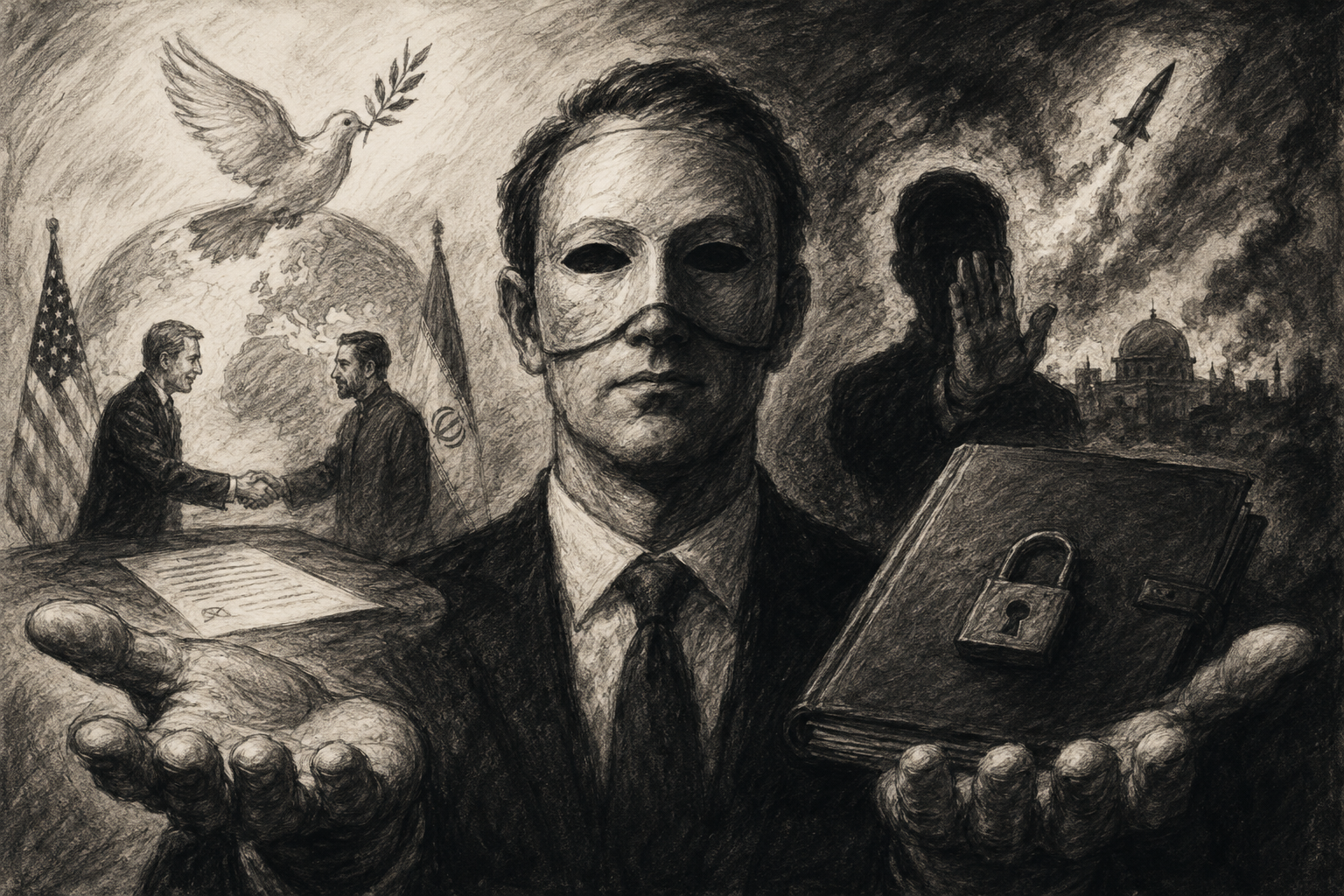
Over the weekend, the United States and Iran put their names to a document meant to end a war. They signed it digitally on Sunday, with a formal ceremony set for Friday in Switzerland. The text is short. A framework, really, the kind of document that expresses and intends and conveys willingness, with the hard specifics pushed into technical talks that have not happened yet. The 2015 nuclear agreement it gestures back toward ran well over a hundred pages once you counted the annexes. This one leaves the details for later.
Then, on Tuesday, the fact that matters surfaced. Israel asked to read the text, and Washington declined.
That is the one to hold onto. A refusal to show the document does not reconcile with the celebration around it, and the detail that will not reconcile is almost always where the truth is hiding. Set aside the page count, the soft verbs, and the large dollar figure that one official waves off as fake news while the reporting treats it as a live provision. Watch the fact nobody wants you to sit with. The party most affected by the agreement asked to see it, and the answer was no.
Ambiguity Is the Hardest Thing to Read
What makes this document worth a serious leader's attention, long after the news cycle moves on, is a problem that will not resolve cleanly. Ambiguity is the shared signature of two opposite things.
It is what wisdom looks like when a leader refuses a false binary, holds two opposing models in view, and buys himself the time to build something better than either. It is also what avoidance looks like when a leader cannot face the cost of a real decision and reaches for language vague enough to announce resolution without doing any resolving. The patient strategist and the frightened evader produce the same surface. Soft verbs. Deferred specifics. A posture of restraint that photographs beautifully and commits to nothing.
This is the central difficulty of judging anyone under pressure, in any institution, at any scale. The path of least resistance never arrives announcing itself as cowardice. It arrives dressed as prudence, as an off-ramp, as smarter pressure, as strategic patience. Ray Dalio made the point plainly. When the fighting gets hard, it becomes easier to justify doing what you previously considered wrong, and the trick is that the person doing it stops calling it wrong and starts calling it wise. The real threat is not the bad decision made in the open. It is the self-justifying story, working quietly behind a face of restraint.
So the useful question is not whether the memorandum is ambiguous. Of course it is. The useful question is how to tell disciplined patience apart from comfortable avoidance when both look identical from the outside.
The Fog That Flatters the Negotiator
History gives a clean case of the avoidance version, the kind a serious mind talks itself into.
Henry Kissinger built much of his reputation on what he called constructive ambiguity, language deliberately vague enough that two sides could each claim the same words meant what they needed them to mean. On Taiwan, in the Shanghai Communiqué, it was a real act of statecraft. It let two governments that refused to acknowledge each other sign the same page. Used well, the technique buys time and room, and Kissinger used it well more than once.
The danger lives inside the same mechanism. Ambiguity that lets everyone claim a win can also let the other side's purpose quietly prevail while flattering the negotiator who secured the words. Nixon, for all his faults, had a habit of seeing the cold reality underneath the language his own diplomacy dressed up. On the Vietnam tapes he told Kissinger to be "perfectly cold-blooded about it," naming South Vietnam as a pawn in a larger game even while the public register spoke of peace with honor. The principal saw what the soft phrasing was built to obscure. The fog was doing work, and the work it was doing was concealment.
Churchill stands as the inverse, and the 1930s are the cleanest example. While the British establishment reached for reassuring language about a durable peace, Churchill said the hard thing plainly. He named German rearmament for what it was at a moment when naming it cost him his standing for years. When Chamberlain came home from Munich and promised "peace for our time," the comfort was in the vagueness, and the vagueness was wrong. Where the evader treats ambiguity as a refuge, the serious leader treats clarity as the tool that sharpens the moral question.
That contrast is the whole tell. Clarity exposes the stakes; fog hides whether they were ever met.
The Counter-Reading Is Strong
Now the honest part, because a one-sided argument here would be its own kind of avoidance.
A defensible reading of this document amounts to patience rather than evasion. The memorandum is a pause button, not a finish line. Performance comes first and relief comes later. The red lines are documented now, they will be tested, and then they will be enforced. Refusing the false binary of peace deal versus no deal is exactly what an integrative mind does. Roger Martin built a career describing this move. Opposing models are to be worked, not feared, and the wise leader holds the tension rather than collapsing prematurely to one side.
If that reading is correct, the soft language is not a hiding place. It is room. It is a leader giving himself the time to construct a better model than either option on the table, which is precisely the discipline Martin prescribes.
This is what makes the judgment genuinely hard, and any analysis that pretends otherwise is selling something. The same restraint that looks like cowardice from one angle looks like wisdom from another. You cannot resolve it by reading the verbs more carefully, because the verbs are identical in both cases. You need a test that does not depend on guessing the leader's intentions, because intentions are invisible in real time. You need something you can audit now.
What You Can Actually Audit
Gary Klein gives the working tool. He calls it the Tilt Reflex, the discipline of refusing to smooth over the contradiction that will not reconcile, the way a good detective fixes on the one detail that does not fit while everyone else moves on. The contradiction you are tempted to wave away is exactly where the answer lives. Replace the irritation with curiosity, and follow the thing that does not add up.
Run the memorandum through that reflex and the signals are everywhere the celebratory framing wants them gone. Israel asked to see the text and was refused. A large reconstruction figure is fake news in the president's mouth, a reported provision of the agreement in the New York Times, and a Gulf-funded pool of money the vice president says Iran could access on good behavior, all in the same news cycle. The vice president insists Iran receives no cash even as he describes that fund and as Iranian reporting points to frozen assets being freed. The timing aligns a little too neatly with not wanting a war on the world's screens during a World Cup. A short framework claims to settle what a document a hundred times longer once tried to nail down.
Put Klein and Martin together and you get a single usable test. It has two prongs, and the first one settles most cases on its own.
The first prong is concealment. An integrative thinker exposes the clashing models, because working the contradiction in the open is how the better answer gets built, while the evader buries them. So the question is whether the contradictions are being surfaced and worked, or suppressed. Refusing Israel the text is suppression, and it fails the test independent of what the text actually says. You do not need to read the document to know that hiding it from the party most affected by it is the behavior of someone smoothing a contradiction rather than honoring it.
The second prong is the end state. Martin ties patience to agency. The wise leader believes he is capable of finding a better model and gives himself the time to create it. So the question is whether there is a defined better outcome being actively built underneath the ambiguity, or whether the ambiguity is terminal. Fog with architecture behind it is patience. Fog with nothing behind it is indecision wearing patience as a costume.
The Honest Limit
The second prong has a weakness worth naming out loud, because a test you cannot run is no test at all. You usually cannot see the end state in real time. The integrative thinker and the evader look identical from outside until the future arrives and reveals which one was building something. Lean too hard on the end-state prong and it quietly becomes a device for confirming whatever you already believed.
Which is why the first prong carries the weight. You cannot audit intentions. You can audit whether a leader is honoring his contradictions or burying them. The refused text is the strongest data point available, not for what it contains, but because the act of hiding it is a tell you can observe today.
A complication remains, and honoring it is the price of using this method honestly. On the same Tuesday the refusal surfaced, the president said he would send the agreement to Congress and read it to the public word by word, so that, in his phrasing, the press would cover it accurately. Take that seriously. If the full text genuinely reaches Congress and the public, the concealment prong updates, and a disciplined reader has to let it update rather than cling to the earlier read out of stubbornness.
But notice the shape of the promise. Disclosure offered on the leader's own schedule, after the ceremony, narrated aloud in his own voice so the coverage comes out right, is not the same act as letting the affected party read the document now. One is a controlled release. The other is access. The first still decides what you see, and when, and how it is framed. So the refusal is not erased by the promise. It is reframed, and the reframing is its own piece of data. A leader honoring his contradictions hands you the page. A leader managing them hands you a reading of the page, later, on his terms.
How to Read the Next Ambiguous Move
The discipline is to stop guessing at the heart and start reading the handling. The same sequence works for a memorandum, a corporate strategic review, or a hard decision dressed up as deliberation.
Start by naming the contradiction the framing wants you to ignore. There is always at least one. Find the fact that does not reconcile with the confidence around it, and put it at the center of your attention rather than the margin. Then run the concealment prong, which is the one that does most of the work. Ask whether the clashing models are being surfaced and worked or quietly hidden, and treat any refusal to disclose as a signal in its own right rather than as missing information.
Suppression fails the test regardless of content. Run the end-state prong next, and run it with humility. Ask whether there is a defined better outcome being actively built, or whether the fog is terminal, and tag that read as something you can only confirm later, so you do not claim a certainty you cannot have. When you hear smarter pressure, or off-ramp, or strategic patience, strip the costume and ask whose purpose is served and whose is not. The label is not the evidence. And keep separate what you can audit now from what you cannot. Concealment and timing are present-tense facts, while end state and intention are either still in the future or invisible altogether. Build your judgment on the first set and hold the second set lightly.
The single most transferable idea here lives in the concealment prong. The hiding is the signal, not the absence of one. When a leader will not show you the thing he is asking you to trust, you already have your answer about the kind of patience he is keeping, and you have it before the future arrives to confirm it.
A leader who reaches for fog instead is running what I have come to think of as the Seneca Shadow. The framework that explains the framework grows faster than the framework gets lived. Each accommodation is defensible on its own, and the aggregate drifts toward something the stated principles would condemn. It is the most respectable way a code dies, one reasonable exception at a time, narrated the whole way down as wisdom.
The Standard Worth Keeping
A leader carrying a real code does not have to hide his contradictions, because working them in the open is how he earns the patience he claims. He shows the text. He names the tension. He tells you what he is waiting for and what would have to be true for the waiting to end. The clarity costs him something in the moment, and he pays it, because the alternative is a fog that protects him today and indicts him later.
That is the standard to hold, in geopolitics and in every room where a hard call is being deferred under the flattering language of restraint. Patience that serves an objective will let you read the document. Avoidance that serves comfort will tell you the document is private and the verbs are enough.
Watch how the contradiction is handled. The honest leaders are already showing you theirs.