Part of: The Leadership Honor Code
The Only Thing That Still Scales
Part of the Leadership Honor Code cluster
In this dispatch
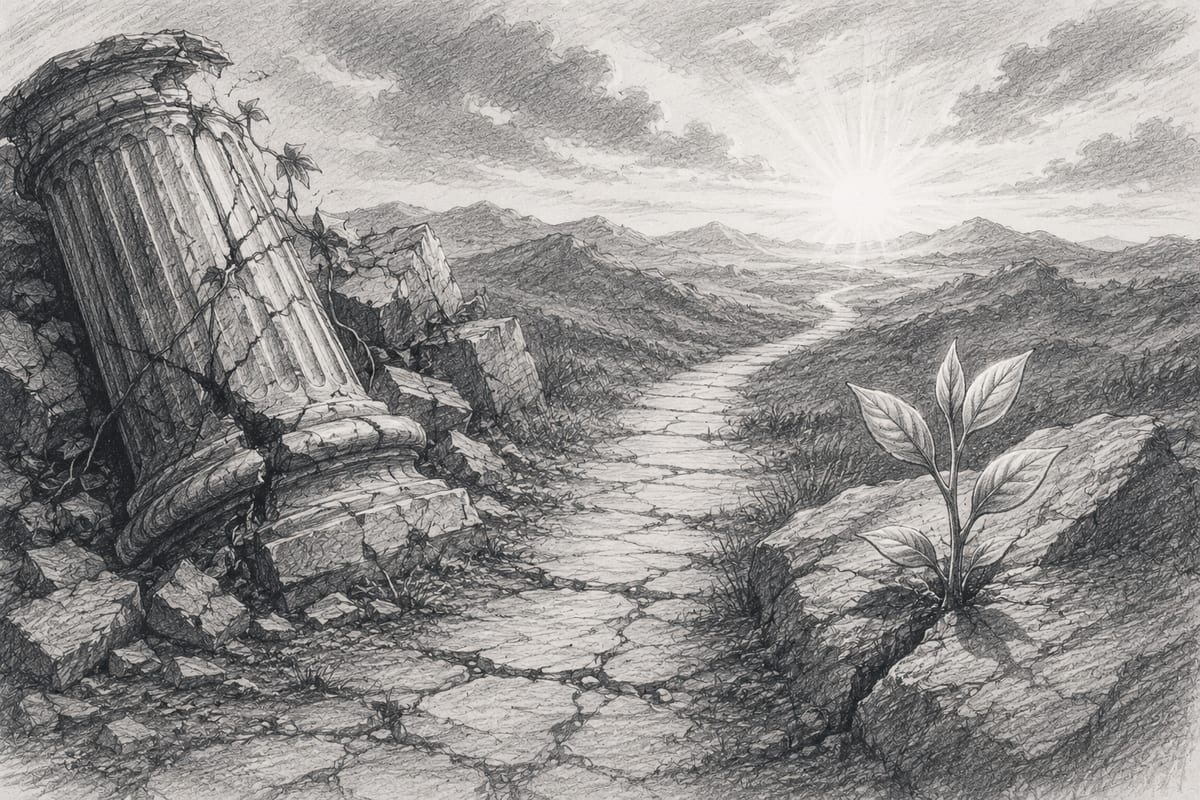
Character is the only leadership trait that still scales because it is the thing that makes hard decisions hold. When institutions lose their authority and trust collapses, people stop trusting the org chart and follow the leader in front of them who can be believed.
Three numbers came out this spring, and together they tell a story most leaders are still trying not to hear.
The first is from Gallup. Global employee engagement fell to twenty percent in 2025, the lowest level since the pandemic shutdowns and the first time in over a decade it has dropped two years running. Gallup puts the cost of all that disengagement at roughly ten trillion dollars in lost productivity, about nine percent of global GDP.
The second is from Deloitte. Most organizations are pouring money into AI with a technology-first mindset, and the ones doing it that way are 1.6 times more likely to miss the returns they expected, compared with the ones that designed the work around people first. Deloitte titled the whole report "Choosing the human advantage," which should tell you where the smart money is starting to look.
The third is from Edelman. Seven in ten people now say they are unwilling or hesitant to trust anyone whose values, background, or way of seeing the world differs from their own. We have retreated into smaller and smaller circles of trust.
Put those together and you have the defining management problem of this decade. People are checked out. The machines we bought to fix that are underdelivering. And the social glue that used to hold organizations together is dissolving in real time.
The Tools Were Built for a Calmer World
Most of the management apparatus we rely on was designed for a different climate. Dashboards, scorecards, elaborate strategic frameworks, optimization models: all of them assume reasonably stable institutions, reasonably rational actors, and enough time to course-correct when the numbers drift. They are instruments of fine-tuning. They work beautifully when the ground is steady.
The ground is not steady. Deloitte's own framing is that the pressures on organizations are no longer arriving in sequence but compounding all at once: technological upheaval, economic volatility, geopolitical strain, and a workforce whose expectations have shifted underneath everyone's feet. When pressures compound, the very complexity that made an organization efficient in calm weather becomes a liability. Every additional layer of process is one more thing that can seize up under load.
Nassim Taleb has spent a career making this point about systems. The fragile thing is the one that has been so finely tuned for a single set of conditions that it shatters the moment conditions change. The complicated machine looks impressive right up until the inputs stop behaving, and then it fails all at once, with no margin and no graceful degradation. A great deal of modern corporate sophistication is fragile in exactly this way. It is optimized for a world that is no longer the one we live in.
This is what people miss when they treat the engagement numbers as a morale problem to be solved with another survey. The drop is the system telling you it is overloaded. We have asked people to absorb more tools, more change, more dashboards, and more reorganizations than the human operating system was built to carry. The fix is not a better dashboard.
Winter Rewards Different Skills
Neil Howe and the late William Strauss gave us a useful frame for this. History moves in long generational seasons, and we are deep in the one they called the Fourth Turning, the winter of the cycle. It is the period when the institutions built up over the previous decades lose their authority and have to be remade. The claim is not mystical. It is a pattern observation: roughly every eighty years, a society's trust in its institutions hollows out, a crisis forces a reckoning, and a new order gets built on the other side.
The Edelman data is what that winter looks like measured in real time. When seven in ten people will not extend trust across difference, and when the institutions still holding people's confidence are the close and the personal, the "my employer," the direct manager, the colleague at the next desk, you are watching abstract institutional authority give way to something older and more human. People stop trusting the org chart. They start trusting the person in front of them.
Here is the part worth holding onto. The skills that win in winter are not the skills that won in autumn. The long expansion rewarded leaders who could scale complex systems, optimize at the margin, and run vast machines of process. Winter rewards something simpler and far harder to fake. It rewards the leader who can stand in front of a frightened team and be believed.
History keeps making the same point. The leaders who carried their countries through the last great crisis era did not do it with superior planning documents. Lincoln held a fracturing union together with moral clarity and an almost unbearable steadiness. George Marshall earned the trust of presidents and generals not through brilliance of maneuver but through a character so reliable that people organized themselves around it. The spreadsheets mattered. They were never what scaled.
The Soft-Skills Objection
This is usually where the hard-nosed reader checks out. Character, empathy, human-centered leadership: it can all sound like the language of a wellness offsite, a way of dressing up avoidance as virtue. I run a company. I know exactly how that objection feels, because I have made it myself in rooms where the numbers were ugly and someone wanted to talk about feelings.
So let me be clear about what I am not saying. I am not saying warmth is a substitute for results, or that being liked is the same as being effective, or that you can feel your way out of a bad quarter. The leader who confuses kindness with the absence of hard decisions does not last, and should not.
What I am saying is that character is the thing that makes the hard decisions hold. Empathy without accountability is indulgence. Accountability without empathy is just fear, and fear does not scale in a low-trust world, because frightened people hoard effort, hide problems, and leave the moment they can. The two have to travel together. When a leader is trusted, a layoff can be handled in a way that keeps the survivors whole and treats the departed with dignity. When a leader is not trusted, the same decision detonates whatever loyalty was left.
I see the cost of getting this wrong from two directions, and the dissonance is real. I make hiring decisions, and the math on entry-level work is genuinely brutal right now; the case for automating a junior role instead of filling it gets stronger every quarter. Then I walk into a classroom and look at twenty-two-year-olds who did everything we told them to do, and I feel the full weight of what those decisions add up to across an economy. I cannot unsee either view. The only honest way I have found to hold both is to insist that the hard decisions get made by people of character, out loud, with the human cost named rather than hidden.
What It Actually Looks Like
Strip away the consultant vocabulary and human-centered leadership comes down to a handful of concrete moves, the same ones that show up whenever you study people who led well through hard seasons. I find myself returning to five of them.
The first is holding a line. Every leader has boundaries they will not cross, and in calm times those boundaries rarely get tested, so no one knows whether they are real. Cato the Younger built an entire political identity on lines he would not cross, and while his absolutism eventually cost him everything, it also made him the one Roman whose word no one questioned. People follow leaders whose limits are known. Ambiguity about what you will and will not do is, by itself, a trust killer.
The second is restraint, the voluntary limitation of your own power. This is the rarest move in the catalog and the most valuable in a low-trust world. When Washington handed back his commission rather than ride his popularity into something larger, he did the one thing that made the new republic believable: he proved authority could be held loosely. Every time a leader chooses less power when more is available, they make a deposit in an account that pays out precisely when everyone else is grasping.
The third is the private test, the midnight moment when no one is watching and the small rationalization is right there for the taking. Seneca, who wrote more eloquently about virtue than almost anyone, also talked himself into serving Nero and accumulating a fortune his own philosophy would have refused. Character is mostly decided in those unobserved moments. The compromises that destroy leaders almost never start large.
The fourth is the willingness to be changed by what you learn. Lincoln entered the presidency with views on race and union that he revised, publicly and at real political cost, as the moral weight of the moment pressed on him. The leaders who calcify under pressure lose people. The ones who keep a growing edge, who can honestly say they see further now than they did a year ago, tend to be the ones still standing.
The fifth is transmission: building so the mission outlives you. Marshall ran the largest mobilization in American history and spent his authority making himself unnecessary, designing systems and developing people so the work would continue without him. The leader who optimizes for personal indispensability is fragile by design. The leader who builds for succession is the one whose results actually compound.
The Playbook
None of this is abstract. Here is where it turns into behavior you can start this week.
Trade some KPI reviews for character check-ins. Gallup is blunt that engagement is built or destroyed at the team level, and that the single biggest variable is the manager. The metrics review tells you what happened. A real conversation about how someone is actually doing, what they are carrying, where they feel stuck, is the thing that moves the number the metrics measure. Do both, but stop pretending the dashboard is the relationship.
Put your actual voice on the communication. People have retreated into trusting the close and the personal: their manager, their colleague, the leader they can picture as a human being. A polished memo from "the company" reads as noise. The same message in your own plain words, owning the hard parts, reads as trust. The medium here is you.
Use AI to amplify judgment, not to replace it. The data on this is now hard to argue with. An MIT study found that of roughly forty billion dollars in enterprise AI spending, ninety-five percent of organizations saw no measurable profit impact, and Deloitte found that only six percent of leaders feel they have actually designed how humans and machines should work together. The winners are treating AI as leverage on human judgment, creativity, and relationships, the very things Deloitte named as the source of competitive differentiation. The losers are buying tools and hoping.
Model accountability out loud. When something fails, and in a compounding-crisis environment something always will, the instinct is to manage the message. Resist it. The leader who names the mistake, owns their part, and says plainly what changes next does more for trust in five minutes than a year of good quarters. Trust is built in the open handling of failure, not the avoidance of it.
Name the human cost. Then decide anyway. The hardest decisions of this era have real victims, and pretending otherwise insults everyone watching. Say the quiet part. Acknowledge who bears the weight of the call. Then make the call, because flinching from hard choices is its own failure of character. People can follow a leader who does difficult things honestly. They cannot follow one who pretends the difficulty isn't there.
This Is the Exam
None of this is a forecast. The numbers from Gallup, Deloitte, and Edelman read like a weather report for the room you are already standing in. The sorting has begun.
Take that as good news. A proving ground does not care about your title, your tenure, or how polished your last deck was. It asks one question, over and over, in a hundred small moments a week: when it costs you something, are you who you say you are? Most careers never get tested hard enough to force a clean answer. We are not going to have that problem.
So stop waiting for conditions to settle before you decide to lead well. They will not settle. The leader you intend to become under pressure is the one you are building right now, in today's decisions, while you still think the real test is somewhere out ahead of you. It isn't. Character is the only thing that still scales, and the clock is already running.
- Character is what makes hard decisions hold.Empathy without accountability is indulgence, and accountability without empathy is just fear. Fear does not scale in a low-trust world, so the two have to travel together.
- Winter rewards different skills than the expansion did.The long expansion rewarded leaders who could scale complex systems and optimize at the margin. A crisis rewards the leader who can stand in front of a frightened team and be believed.
- Most management tools were built for a calmer world.Dashboards, scorecards, and optimization models assume stable institutions and time to course-correct. When pressures compound at once, that complexity turns fragile and seizes up under load.
- Character-driven leadership comes down to five concrete moves.Holding a line, restraint, passing the private test when no one is watching, being changed by what you learn, and transmission that builds so the mission outlives you.
- AI underdelivers when it replaces judgment instead of amplifying it.Ninety-five percent of enterprise AI spending showed no measurable profit impact. The winners treat AI as leverage on human judgment, creativity, and relationships.
Frequently asked
Why is character the most important leadership trait right now?
Character is the thing that makes hard decisions hold. Empathy without accountability is indulgence, and accountability without empathy is just fear. In a low-trust world fear does not scale, because frightened people hoard effort, hide problems, and leave the moment they can. Character is what lets a leader be believed when it costs something.
What leadership skills matter most in a crisis or downturn?
Winter rewards different skills than the long expansion did. The expansion rewarded leaders who could scale complex systems and optimize at the margin. A crisis rewards something simpler and harder to fake: the leader who can stand in front of a frightened team and be believed.
Is human-centered leadership just soft skills?
No. Warmth is not a substitute for results, and being liked is not the same as being effective. Character is what makes hard decisions hold, not a way to avoid them. The honest move is to make hard calls out loud, with the human cost named rather than hidden.
Why is AI not improving productivity for most companies?
Most organizations buy AI with a technology-first mindset and see no return. An MIT study found ninety-five percent of enterprise AI spending produced no measurable profit impact, and only six percent of leaders designed how humans and machines work together. AI should amplify human judgment, not replace it.
How do you build trust when trust is collapsing?
Put your actual voice on the communication and model accountability out loud. People now trust the close and the personal: their manager, their colleague, the leader they can picture as a human being. Name the mistake, own your part, and say what changes next. Trust is built in the open handling of failure.
Leaving Power on the Table
Voluntary limitation built the American experiment. Its absence is showing up everywhere leadership matters, and the bill is coming due
The Proximity Paradox
When you serve a chaotic master, influence and complicity grow on the same vine. The hardest discipline is seeing the moment they trade places.