The crisis era · A practical guide
The Fourth Turning, Explained
The Fourth Turning is the crisis phase of the generational cycle proposed by William Strauss and Neil Howe. In their model, a roughly 80- to 100-year cycle ends in about two decades of upheaval, when institutions face breakdown and renewal.
Make a call you can explain.
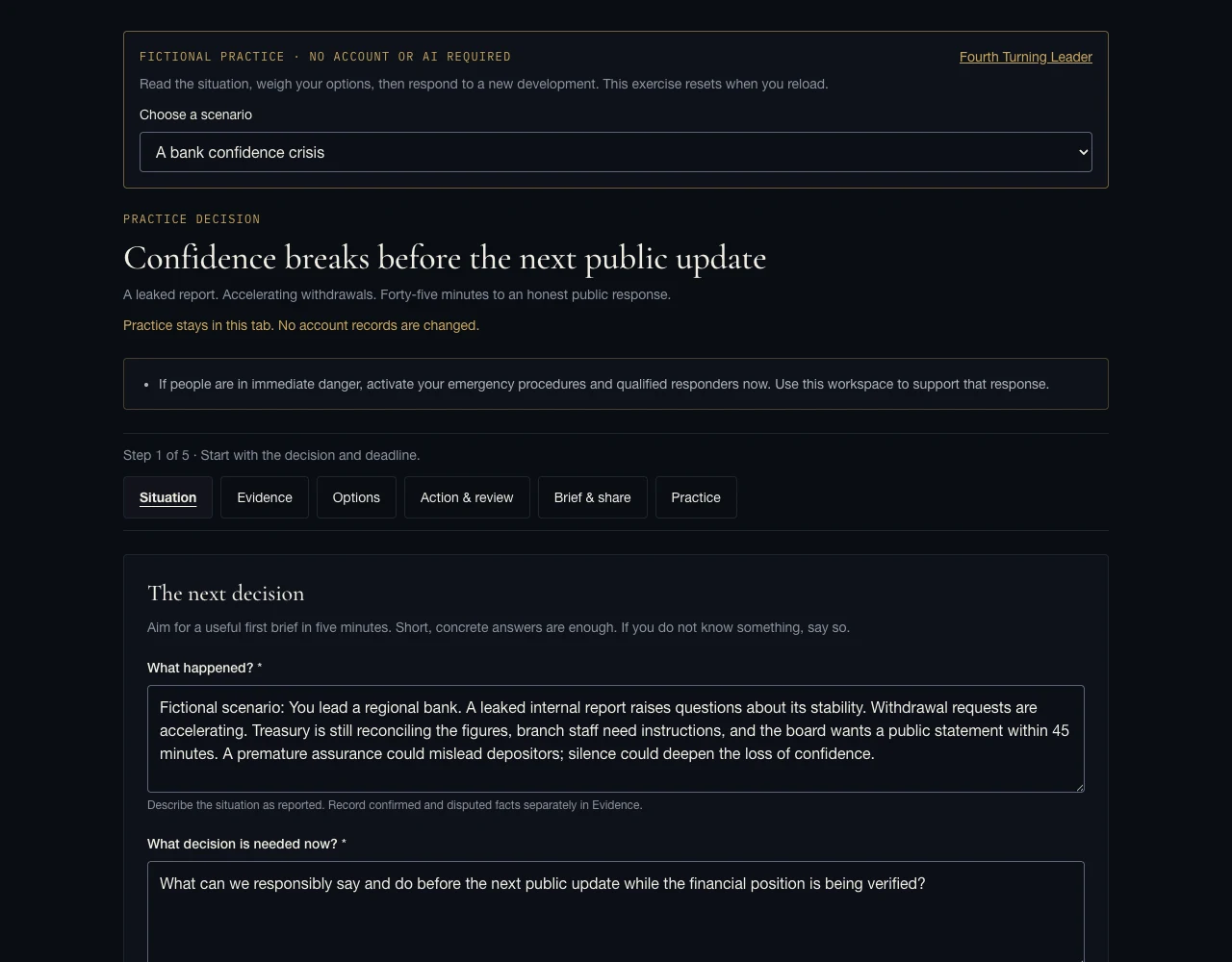
Lead through a cyber disruption, abrupt leadership loss, or broken trust. Practice with a fictional bank crisis. Download your decision brief.
Build my free decision briefFour steps. Untimed. No account required.
Inside the Leader Lab
Make the call.
Show your reasoning.
The rehearsal gives you a place to turn an uncertain situation into a decision brief: what you know, what you owe, what you will do, and when you will reconsider.
- 01Separate facts from assumptions.
Work from what is verified. Make the unknowns visible.
- 02Weigh the cost of the call.
Name the people and obligations each option puts at risk.
- 03Write the next move.
Give the decision an owner, an action, and a review trigger.
Four steps. Untimed. No account required.
Understand the era
What the
Fourth Turning is
A Fourth Turning is the final stage of the Strauss–Howe generational cycle, or saeculum. The authors compare its four stages to seasons. The crisis is winter: the period when an old civic order faces pressures it can no longer contain.
Strauss and Howe introduced the framework in Generations (1991) and developed it in The Fourth Turning (1997). It describes the setting in which many consequential decisions accumulate, across an era broader than a single election, recession, or emergency.
One cycle · Four eras
The four turnings
Each era shapes the generation that comes of age within it. Dates below are approximate, following the Strauss–Howe interpretation.
- 01First Turning
The High
1946–1964
After a crisis, confidence returns. Institutions are strong, and a shared order takes shape.
- 02Second Turning
The Awakening
1964–1984
A new generation challenges the values and authority of the established order.
- 03Third Turning
The Unraveling
1984–2008
Individualism grows. Institutional confidence weakens, and shared purpose fragments.
- 04Fourth Turning
The Crisis
2008 onward, in Howe’s account
Accumulated conflicts demand resolution. Institutions face a test of legitimacy, survival, and renewal.
The idea and its limits
The Strauss-Howe
generational cycle
The proposed mechanism is generational memory. People shaped by a crisis build institutions to prevent its return. Later generations inherit those institutions without the same lived experience, challenge their constraints, and eventually face pressures that require a new settlement.
The authors cite the American Revolution, the Civil War, and the Depression and Second World War as crisis-era examples. Howe dates the current turning to around 2008. His 2023 book projects a crisis climax in the early 2030s; that remains a forecast.
Use the lens. Keep testing the evidence.
Treat the Fourth Turning as an interpretation of history. The dates are approximate, and its predictions remain uncertain. It cannot tell you whether a particular bank will fail, a conflict will escalate, or a technology will overturn your organization. Decisions still require current evidence, relevant expertise, and people willing to challenge your assumptions.
Read the sources: Strauss & Howe, 1997 · Howe, 2023
What it asks of leaders
Trust. Authority.
Continuity.
A bank confidence crisis, a major cyber disruption, or an abrupt leadership loss can turn an operating problem into a test of whether your institution deserves people’s trust.
- Speak without false certainty.
- Say what is verified and when people can expect the next update.
- Make competing obligations visible.
- Name whose interests your decision protects and who bears its costs.
- Give authority a limit and an owner.
- Record who makes the call and what evidence triggers a review.
A personal honor code gives you commitments to test. The five leadership modes offer approaches to holding a line, exercising restraint, and building institutions that endure. You can practice both while questioning the historical cycle.
The book behind the practice
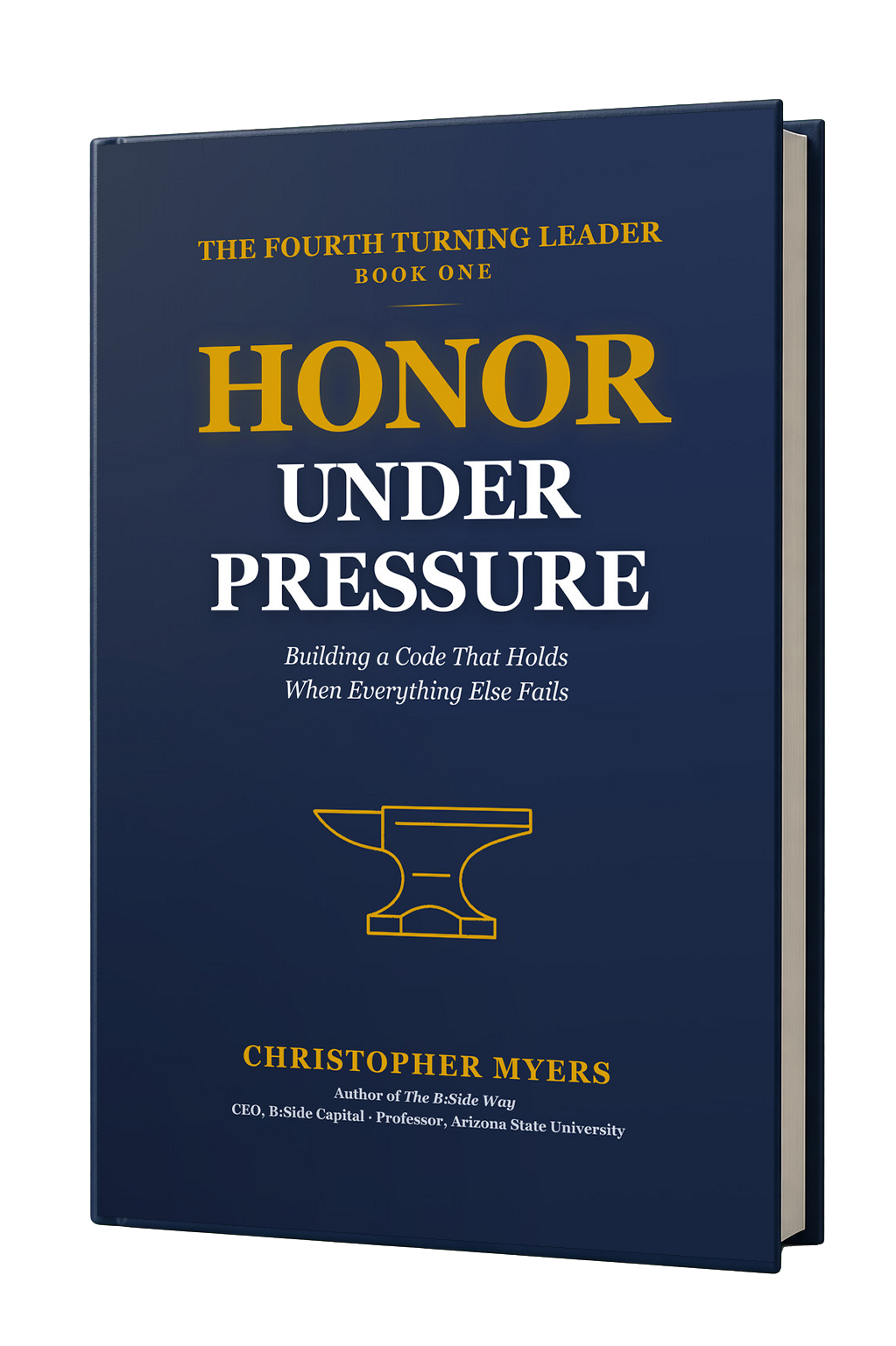
Honor Under Pressure
Build a code that holds when institutions are under strain.
Chris Myers draws on Cato, Washington, Seneca, Lincoln, and Marshall to explore duty, restraint, and judgment under pressure. Read the framework behind the practice, then bring it to the decisions you face.
Explore the book
Chris Myers
CEO of B:Side Capital and B:Side Fund. Entrepreneurship faculty at Arizona State University. Read Chris’s background.
A few useful answers
Common questions
What is the Fourth Turning in simple terms?
The Fourth Turning is the crisis phase of the generational cycle proposed by William Strauss and Neil Howe. In their model, a roughly 80- to 100-year cycle ends in about two decades of upheaval, when institutions face breakdown and renewal.
What are the four turnings?
The four turnings are the High, when confidence and institutions are strong after a crisis resolves; the Awakening, a values revolt against that order; the Unraveling, when institutions weaken and trust erodes; and the Crisis, when the old order breaks down and is rebuilt. Together they form one long cycle that historians William Strauss and Neil Howe called the saeculum, about the length of a long human life.
Who created the Fourth Turning theory?
The theory comes from William Strauss and Neil Howe, who introduced it in Generations (1991) and developed it in The Fourth Turning (1997). Howe updated it in his 2023 book The Fourth Turning Is Here. They traced a repeating pattern of four generational eras through roughly five centuries of Anglo-American history.
When did the current Fourth Turning begin?
Neil Howe dates the current Fourth Turning to roughly 2008, with the global financial crisis as its opening catalyst. In The Fourth Turning Is Here (2023) he reaffirms that start and projects the crisis resolving sometime before the mid-2030s. Exact start dates are a matter of interpretation, since a turning is recognized by its conditions rather than by a single day.
How long does a Fourth Turning last?
In the Strauss-Howe model each turning runs about 20 to 25 years, roughly the length of one generation, so a full cycle of four turnings, which they call a saeculum, spans roughly 80 to 100 years. A Fourth Turning ends when the new order is established and confidence returns, which begins the next High.
What should leaders do during a Fourth Turning?
Clarify what is verified, name competing obligations, and record who owns the decision and when it will be reviewed. The free Leader Lab crisis rehearsal lets you practice with a fictional bank confidence crisis. The Mode Finder offers a separate reflection on patterns in your choices.
Does the Fourth Turning theory predict exactly what happens next?
Treat the Fourth Turning as an interpretation of history. The dates are approximate, and its predictions remain uncertain. It cannot tell you whether a particular bank will fail, a conflict will escalate, or a technology will overturn your organization. Decisions still require current evidence, relevant expertise, and people willing to challenge your assumptions.
Is the crisis rehearsal free?
Yes. The Leader Lab rehearsal opens a fictional bank confidence crisis without an account or payment. You can work through the situation, evidence, options, action and review, and decision brief. Ongoing work with your own saved decisions is part of paid Leader Lab access.
Put the framework to work
When the room turns to you,
what will you stand behind?
Start with the fictional bank crisis. Practice a call you can explain, with the evidence, the trade-off, and the next action in view.
Build my free decision briefFour steps. Untimed. No account required.
The complete Leader Lab
For the decision you carry.
And the ones after it.
A self-guided online workspace for leadership when trust, authority, and continuity are at stake.
- 01Work the decision
- Bring your own crisis decisions into a workspace for evidence, competing options, accountable actions, and a decision brief.
- 02Build the code behind it
- Honor, Culture, and Command Labs for your commitments, organizational standards, and institutional continuity.
- 03Return and follow through
- Saved cases, review prompts, an AI companion, Field Notes, and document exports.
Selected from the Dispatch
Continue the reading
Trust and legitimacy
How Leaders Build Moral Authority Under Pressure
How to earn trust when duties conflict: apply standards to powerful people, preserve dissent, and record the reasoning behind decisions others must live with.
Read the essayDecisions and accountability
Board Decisions During a Crisis Must Hold
A practical guide to crisis governance: clarify who can act, distinguish facts from assumptions, protect dissent, and set triggers for reviewing consequential decisions.
Read the essayMore Fourth Turning essays and resources
Go one level deeper
Articles in this cluster
From the Dispatch
- What Is the Fourth Turning? A Leader's TestWhat is the Fourth Turning? Learn the historical cycle theory, its limits, and what leaders must do when institutions lose authority and fail publicly.
- The Strongman AuditionEvery Fourth Turning ends with strengthened authority. The only open question is its character.
- The Diagnosis Was Never EnoughOn what comes after naming the storm
- The Invisible ArchitectureEvery system you interact with was designed to solve a problem that no longer exists
- Playbooks Over Panic: Writing Your Unexpected Events ManualWhy a living document beats winging it every time
- Read Not the Times. Read the Eternities.Why stepping away from the noise might be the clearest move a leader can make
- The Crisis EraWhat It Means, Where We're Headed, and Why It Matters Now
- Building Mental ToughnessHow To Develop The Strength to Endure and Adapt
- The Freedom TrapWhen More Options Lead to Less Satisfaction
- Shifting the Overton Window in LeadershipHow Bold Ideas Become the New Norm
- Rising to the MomentPreparation Meets Opportunity
- The Path ThroughFacing Obstacles Head-On
- The Strength of SimplicityHow clear, focused leadership builds trust and drives success
- Coaching vs. Management vs. LeadershipThe Bill Campbell Way
- The Transformative Power of Positive ReframingLearning to say “Good”
- Confronting the Dark SideTurning Repression into Strength
- Lessons from Hannibal’s Tactical GeniusThe Value of Adaptability
- Simplicity as a Cultural ValueBuilding a Simple Organization
- Embracing Imperfection in LeadershipLessons from Montaigne
- The Power of Letting GoThe Paradoxical Approach to Unlocking Solutions
- The Power of Doing Your BestA Mother's Day Message That Stuck
- Don't Be a "Pigeon" CEOGrowing Beyond the "Swoop and Poop" Leadership Style
- From Reflection to RenewalAn Easter Season Guide for Leaders Navigating Change
- Empowering ExcellenceStrategies for Leading High Achievers to Success
- Mastering the Art of ChangeLessons in Swift Adaptation
- Compassionate CandorStraightforward Communication for Stronger, More Empathetic Teams
- Safeguarding Your Core Mastering the Center-of-Gravity Strategy
- Avoiding GroupthinkHow to Lead Without Imposing and Encourage Independent Thought
- Talent Recruitment and Retention J. Robert Oppenheimer's Leadership Genius Behind the Manhattan Project
- Navigating the SpotlightHow Subtlety and Restraint Propel Leadership Success
- The Litany Against FearA Leadership Lesson from Dune
- The Art of Strategic Detachment Cultivating Clarity, Resilience, and Focus in a Turbulent World
- Elevating SuccessThe Power of Amplifying Others' Achievements
- Beyond Quick Fixes The Transformative Power of Thoughtful Decision-Making in Leadership
- Breaking the Mold Creative Leadership in Traditional Industries
- Awakening from the Great NapNavigating the Fourth Turning with Resilient Leadership and Disciplined Wisdom
- Empathetic Digital LeadershipNavigating the Human Element in a Technology-Driven Era
- The Art of Giving A DamnTurning Intense Feelings into Creative Power
- White Space ManagementBalancing Energy in Leadership
- Valuing the InsignificantA Leader's Eye for Detail
- Help-Seeking Leadership:The Power of Vulnerability in Feedback