Part of: The Fourth Turning, Explained
The Strongman Audition
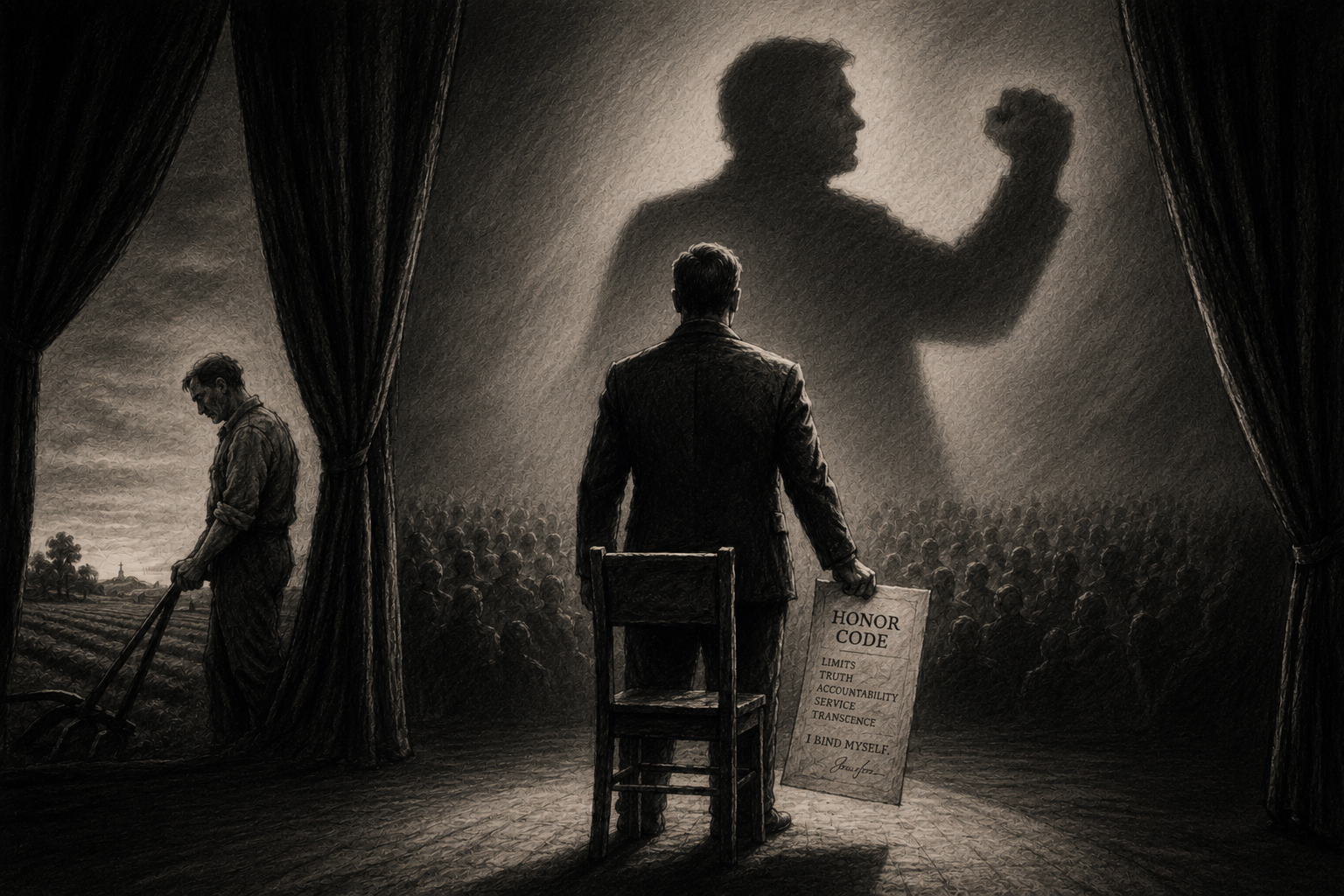
Most commentary on rising authoritarianism treats it as a foreign disease, something infecting an otherwise healthy body politic. Read the history of Crisis eras and you come away with a colder conclusion. The hunger for strong authority is not an infection. It is the weather. Every Fourth Turning produces it, on schedule, and this one is producing it right now, exactly as the pattern predicts.
That reframing changes everything. If authoritarianism is a disease, the cure is to suppress the symptom, to lecture people out of wanting strong leaders. If it is the weather, the demand cannot be lectured away. It will be answered. The only question left, and it is the question this entire era turns on, is what answers it. So this is not another essay warning you that the strongman is coming. He is already here, auditioning, at every level from the White House to the school board to the company all-hands. This is an essay about the other man in the wings. The audition has two endings, and the difference between them has never been the strength of the demand. It has been the character of the supply.
01 : Winter always calls for a strongman
Strauss and Howe were blunt about how Fourth Turnings end. They end with society reconsolidated under strengthened authority. Not weakened authority. Not restored committee process. Strengthened authority, wielded by leaders the community actually follows.
Think about why. A Crisis era is, by definition, the season when the old institutions stop working, and people who watch institutions fail do not respond by loving process more. They respond by transferring their trust from systems to persons. We can already measure the transfer. Seven in ten people now say they will not trust someone with different values. Institutional confidence has been in freefall for a generation. The trust did not evaporate. It is looking for somewhere to land.
That landing is the whole game. The theory has a name for the figure who catches it, the Gray Champion, the elder whose character was tested over decades and who steps forward when everything else is cracking. Here is what the theory does not guarantee: that he is a Lincoln. The demand is structural. The supply is a choice. Winter does not ask whether we will have strong leaders. It asks what the strength will be made of.
02 : The last American winter almost went the other way
We tell the story of the Depression and the war as if the outcome were destiny. It was not. The last Fourth Turning ran its own strongman audition, and for a few years the strongman was winning.
By 1935 Huey Long had turned Louisiana into something close to a personal state, claimed millions of Share Our Wealth members nationwide, and was preparing a presidential run that Roosevelt’s own people considered genuinely dangerous. Father Coughlin preached to a radio audience in the tens of millions, blending grievance with conspiracy until it curdled into something darker. Respectable American opinion praised how Mussolini made things work. And in 1934, Marine general Smedley Butler testified to Congress that wealthy businessmen had approached him to lead a veterans’ march on Washington and install a government the constitution had no place for. The committee found his core claims credible. We skip that story in the schoolbooks because it embarrasses the destiny narrative.
Long was assassinated before his run. Coughlin was silenced by his bishop. The Business Plot died because the plotters picked a man who would not be bought. And when Roosevelt himself reached too far and tried to pack the Court, his own party stopped him.
Here’s the truth: the last Fourth Turning did not avoid the strongman because Americans were better people than we are. It avoided him because particular leaders held particular lines at particular moments. That was contingency and character, not destiny. Which means it is not destiny now either, in either direction.
03 : The demand is real, and dismissing it hands the field to the counterfeit
If you want to understand why the strongman keeps drawing a crowd, you have to take the crowd seriously, and two books do it better than anything else I have read.
R.R. Reno’s Return of the Strong Gods argues that after 1945 the West concluded that strong loyalties were the problem. Nation, faith, family, truth itself, anything capable of inspiring men to die and kill, had to be weakened and managed. It worked. It prevented fascism’s return for three generations. It also left people homeless, stripped of every commitment larger than the self. And people deprived of legitimate loyalties do not become loyal to nothing. They become available to anyone offering belonging on any terms, and the most debased gods, blood and soil and the leader’s cult, are always hiring.
Robert Kagan’s Rebellion supplies the other half. The antiliberal tradition in America is not new. It runs continuously from the slaveholding South through the 1920s Klan through McCarthy to the present, and it erupts whenever the institutions defending the liberal settlement grow weak. Its fuel is status anxiety, not economic anxiety, which is why it surges in booms as readily as busts. And it wins through accommodation: establishment men who despise the strongman fold to him one career calculation at a time. Ambition, Kagan writes, is a powerful antidote to moral qualms.
Put the two together and you get the honest picture. The strongman is a counterfeit answer to a real question: what can I belong to, and who can I trust, now that the institutions have failed? Tell people they are wrong to ask it and you have not defeated the counterfeit. You have eliminated its competition.
04 : The counterfeit has an operating system
I wrote recently about the Cohn doctrine. Attack, attack, attack. Admit nothing, deny everything. Always claim victory. It is a complete and coherent code, the exact inversion of an honor code, and it keeps winning short rounds.
See it now at the civilizational scale, because the Cohn doctrine is the strongman’s operating system, and the tell is always the same. Ask where the loyalty flows. In every authoritarian project in history, loyalty flows upward to the man and stops there. The strongman binds others to himself. He demands oaths and gives none. He does not ask what the law says, only who the judge is. He consumes the trust that institutions spent generations accumulating and converts it into personal power, winning rounds while strip-mining the commons that makes winning worth anything. Nations that run this operating system end the way the men do: surrounded by flatterers they cannot test, poor and afraid, a hall of paid mirrors with a flag on it.
That is the counterfeit. Now for the part almost nobody writes, because it is harder than pointing at the villain.
05 : The alternative is not weakness
The standard prescription against authoritarianism is more of what created the vacuum. More process, more hedged technocratic caution, leadership so careful it cannot be accused of anything because it does not do anything. Let me be clear about the hinge of this whole piece. You cannot beat a strong god with a spreadsheet. Weak authority is not the alternative to bad authority. Weak authority is the audition stage for bad authority. Every year the self-protective, consensus-laundering leadership class fails to lead is a year the crowd’s eyes drift toward the man who at least sounds certain.
The real alternative is as strong as the strongman and different in kind, and the difference fits in one sentence. The authoritarian binds others to himself. The honorable leader binds himself to something above himself.
Both are strong. Both act. Both wield real authority, which is exactly why the honorable version can compete for the trust that is looking for a home. But only one is safe to follow, because only one has pre-committed to limits that hold when power is offered. That pre-commitment is what I have been calling a leadership honor code: not a values statement, not a vibe, but a set of decisions already made, written and specific, with the costs named in advance and a witness granted standing to call the drift.
Does that ever actually happen? Do strong men actually bind themselves? Every generation that survived a winter knew the stories by heart.
06 : What honor looks like when it holds
The ancients knew the strongman audition intimately, and built their civic imagination around the man who turned it down. Cincinnatus was plowing his field when Rome handed him absolute power to meet an invasion. He took it, used it completely, won, and gave it back in sixteen days to return to the plow. Rome told that story for five hundred years because the giving back was the miracle. Anyone can seize power. The republic runs on the men who return it.
In March of 1783, George Washington walked into a meeting of his own unpaid officers at Newburgh, a room ready to march on the civilian government. He held the line of civilian authority against men who read restraint as weakness, and then, fumbling for his spectacles, remarked that he had grown gray in his country’s service and now found himself going blind. The room wept and the conspiracy died. Months later he surrendered his commission and went home, the American Cincinnatus. George III is said to have remarked that if Washington gave up power he would be the greatest man in the world. He gave it up twice.
Lincoln is the closest thing the theory has to a proven Gray Champion, and the detail that belongs here is the election of 1864. Lincoln wielded more concentrated power than any president before him, in a war for national survival, and in August of that year he privately acknowledged he would probably lose in November. He never considered not holding the election. Maximum power, held loosely, submitted to judgment at the exact moment a strongman would have declared the emergency too grave for voting. That is the whole distinction in a single act.
George Marshall wanted command of the Normandy invasion more than anything in his professional life, and when Roosevelt all but offered it, he refused to ask and let the President decide on the merits. The command and the credit went to Eisenhower. Marshall spent his authority making himself unnecessary, the precise inversion of the strongman, who builds every machine so that it fails without him. And Cato the Younger held the absolute line against Caesar and paid the absolute price at Utica. He lost, and Rome measured honest men against him for three centuries. Cato mode is the rarest and most expensive setting. Most of us are called instead to Washington mode or Marshall mode: restraint and transmission, the strength that hands power back and builds things that outlive it.
Beneath the famous names, the record thins into the multitude that actually decides these eras. Franz Jägerstätter, the Austrian farmer beheaded in 1943 for refusing the oath to Hitler, nobody, expecting nothing. Tyler Shultz and Erika Cheung, lab techs barely out of college, holding a line against a predator running the full Cohn playbook while the adults around them counseled surrender. For every name that made the books there were ten thousand who kept the oath no one witnessed and vanished without a line of record. Fourth Turnings are not resolved by one Gray Champion. They are resolved by whether the society beneath him has enough of these people to build with.
07 : The audition is happening at your scale too
This is not a spectator essay, and the strongman audition is not only being held in capitals.
If you lead an organization, the trust that left the institutions is in the room with you, looking for somewhere to land, and your people are deciding right now whether it can land on you. Every week you are either demonstrating that authority can be strong and bound at the same time, or you are teaching your people that authority cannot be trusted, and that second lesson is the strongman’s recruiting pitch. Write your code now, in the calm, before the pressure starts negotiating with you. A leader improvising his limits under fire does not have limits. He has moods.
If you serve inside a system that is bending, decide in advance which accommodations you will never make. The accommodations that swallow good men never arrive all at once. They arrive one defensible step at a time, and ambition is a powerful antidote to moral qualms.
And if your role in this era is choosing whom to follow, you have a test that cuts through every performance. Do not ask whether the leader is strong; the era will supply strength. Ask what he has bound himself to, and what keeping that bond has already cost him. Ask for the receipts of restraint: the power handed back, the emergency he refused to exploit, the election he submitted to when he expected to lose it. A leader who has never paid for a principle does not have principles. He has positions, and positions convert to whatever the room will pay.
08 : Caesar or Cincinnatus
So let me end where the theory ends, with the part that is not up for a vote. This Fourth Turning, like every one before it, will resolve with strengthened authority. The demand is structural, the trust is already in motion, and the vacuum will be filled. What is up for a vote, and up for a thousand smaller decisions that feel nothing like votes, is the character of what fills it. Rome faced the identical demand twice and produced Cincinnatus once and Caesar once. The difference was not the size of the crisis. It was the men available when the crisis called, and the codes they had or had not bound themselves to long before.
The worst response to this era is to audition for strongman, at whatever scale your ambition operates. The second worst is to decide that strength itself is the enemy and retreat into process and hedge while the counterfeit takes the stage unopposed. The people the next era gets built on do the harder double act: become genuinely strong, strong enough to be worth following through a winter, and then bind that strength to a code, so that when the moment offers them more power than they should take, the decision has already been made, in writing, by a calmer version of themselves, with the costs already counted.
The Gray Champions of the next decade are being formed right now, in unobserved rooms, at every scale, by people deciding what they will not do for a win. The audition is open. It was never really for him. It is for you