CEO Decision Trends Favor Judgment Over Consensus
In this dispatch
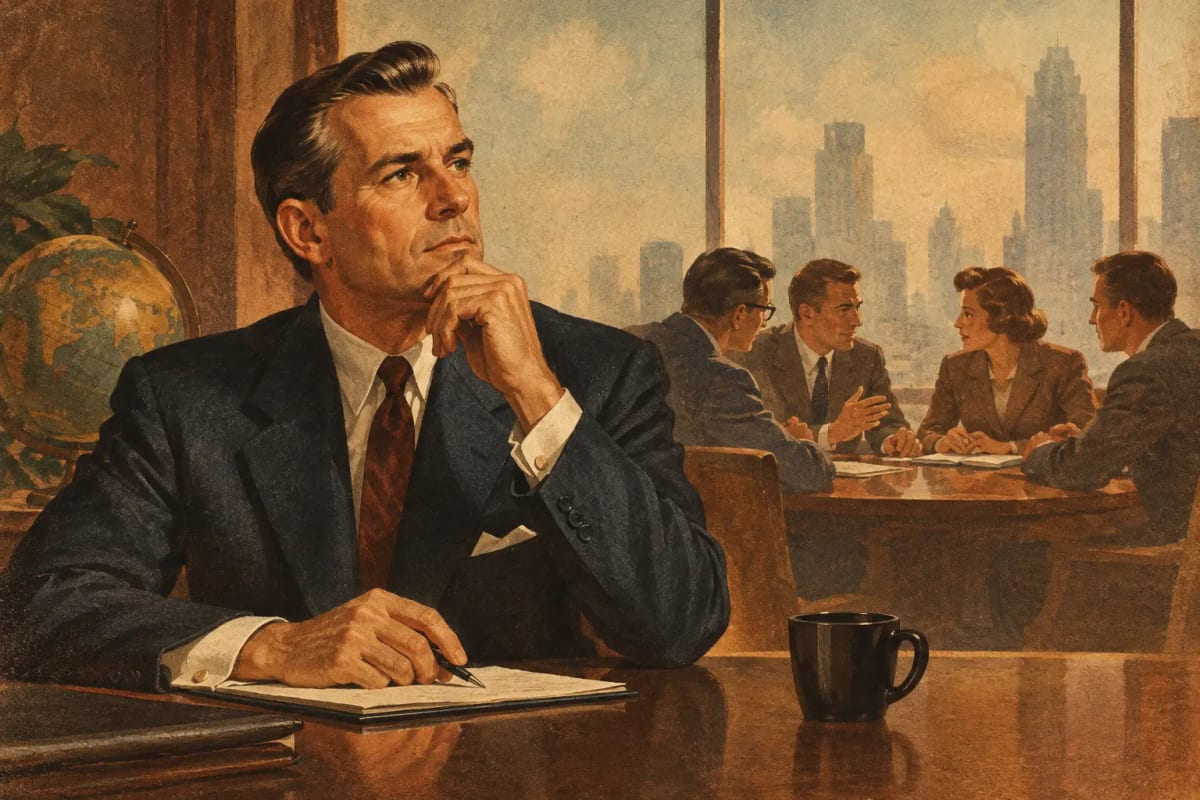
A CEO receives a call at 6:40 a.m. A major customer is threatening to leave. A regulator has asked questions. Two senior executives disagree about what happened. By noon, employees will know something is wrong.
This is where CEO decision trends become real. They are not management fashions or boardroom vocabulary. They reveal what leaders do when information is incomplete, incentives conflict, and delay begins to create its own damage.
The central shift is plain: the age of decision-making by broad comfort is weakening. CEOs are being asked to exercise judgment before consensus forms, then show the record of how and why they acted. The crisis is the audit. It exposes whether authority was held in trust or merely used when convenient.
CEO Decision Trends: From Speed to Defensible Judgment
For years, business culture treated speed as an unqualified virtue. Move fast. Flatten approvals. Do not let perfection obstruct progress. In stable conditions, that instinct can create an advantage. A company that must seek permission for every ordinary operating choice will lose ground to a more decisive competitor.
But speed is not judgment. A fast decision made without defined standards can transfer risk from the executive suite to employees, customers, lenders, and the institution itself. It may solve the immediate problem while creating a credibility problem that lasts for years.
The stronger trend is toward defensible judgment. This does not mean legalistic paralysis or writing a memo before every routine choice. It means that consequential decisions require a clear chain of reasoning: what is known, what is uncertain, whose interests are at stake, which principles govern, what alternatives were rejected, and who owns the next action.
A decision record changes the quality of leadership before it changes the quality of documentation. It forces the CEO to separate facts from assumptions. It reveals when an executive team is hiding behind vague language such as “market conditions,” “best practice,” or “the team’s recommendation.” It also gives the board something more useful than a retrospective story engineered after the outcome is known.
The right question is no longer simply, “Can we make this decision quickly?” It is, “Can this decision withstand scrutiny from the people who will bear its consequences?”
Authority Is Compressing at the Top
Institutional friction is rising. Political pressures, supply interruptions, public distrust, labor disputes, cybersecurity incidents, financing constraints, and cultural conflict increasingly arrive at the CEO’s desk at once. Many cannot be delegated cleanly because each contains a question of legitimacy.
This is producing a second major trend: authority is compressing. Boards still govern. Executives still own functions. Counsel still advises. Yet the CEO is often the person required to reconcile competing obligations when the normal system cannot produce a timely answer.
That reality has a danger. A leader who mistakes compressed authority for personal license becomes arbitrary. A leader who treats every hard call as a group exercise becomes absent. Neither posture sustains an institution.
The better practice is bounded command. The CEO states the decision right, the nonnegotiable standard, the required consultation, and the trigger for escalation. For example, a chief executive may delegate customer remediation within a fixed financial range while reserving any action that affects public disclosure, workforce reductions, regulatory posture, or long-term contractual obligations.
Bounded command gives people room to act without allowing critical standards to dissolve under pressure. It is not centralization for its own sake. It is clarity about where power belongs when consequences are uneven and irreversible.
Optimization Is Giving Way to Resilience
The old operating model favored lean inventories, concentrated suppliers, tightly staffed teams, and quarterly efficiency gains. Those choices were often rational on a spreadsheet. They also assumed that systems would remain reliable and that exceptions would stay rare.
That assumption has weakened. CEOs are now being judged not only by how efficiently they run an organization, but by whether it can absorb shock without abandoning its obligations. Resilience costs money. Redundant capacity, succession depth, cash discipline, scenario planning, and cross-trained leaders all look inefficient until the moment they become the difference between continuity and failure.
This does not require a company to build excess capacity everywhere. It requires leaders to identify where failure would be intolerable. A regional lender may need stronger liquidity and decision protocols. A manufacturer may need supplier alternatives and crisis communications discipline. A university may need a clearer process for disputes that test both campus order and public legitimacy.
The CEO’s work is to distinguish strategic redundancy from waste. That depends on the institution’s mission, exposure, and duty to those who rely on it. There is no universal resilience ratio. There is, however, a universal obligation to know what breaks first and who pays when it does.
Culture Is Becoming a Decision System
Values posters have lost their authority because too many organizations have watched them disappear at the first serious inconvenience. Employees do not learn a culture from the language in the lobby. They learn it from promotion decisions, exception requests, expense approvals, customer disputes, executive conduct, and the consequences imposed when a high performer violates a standard.
That is why culture is increasingly treated as operating architecture rather than morale programming. A CEO must define what conduct earns trust, what conduct triggers intervention, and which decisions require a written record. The aim is not a rigid bureaucracy. The aim is consistency where consistency protects fairness and legitimacy.
A serious culture can tolerate disagreement. It cannot tolerate evasions of responsibility. Senior teams should be able to argue hard about facts, risks, and alternatives. Once the decision is made, the institution needs a clear account of who is accountable for execution and what evidence will show whether the decision held.
This is especially important when leaders face pressure to make exceptions for revenue, status, politics, or personal loyalty. The exception may be warranted. But it should be named as an exception, authorized at the proper level, and recorded with its rationale. Unrecorded exceptions become the real culture.
CEOs Are Relearning the Cost of Silence
Not every public controversy requires a corporate statement. Some issues are outside a company’s competence or duty. CEOs who comment on everything can cheapen their own authority and turn the institution into an instrument of personal identity.
Still, silence is not neutral when employees, customers, or communities reasonably expect the organization to uphold a duty it has already claimed. A safety failure, discriminatory conduct, misuse of customer data, or breach of fiduciary responsibility cannot be managed through carefully passive language. The issue is not whether a statement sounds compassionate. The issue is whether the organization will act, repair harm, and accept accountable scrutiny.
This places moral judgment back at the center of executive work. Legal compliance remains essential, but legality is a floor. A decision can be lawful and still corrode trust. It can be popular and still betray an institution’s purpose. It can protect this quarter’s earnings and damage the conditions that make future earnings possible.
The CEO therefore needs an articulated code before the emergency. Under pressure, people revert to habit, fear, and self-protection. A written honor code gives the leader and the team a standard that existed before the outcome was known. It makes the hard call easier to identify, even when it remains costly to make.
The Practical Discipline: Decide, Record, Drill
The leaders best prepared for this environment do not wait for a public failure to discover how they decide. They practice. They run scenarios involving fraud allegations, lender distress, executive misconduct, hostile media attention, cyber extortion, succession disruption, and a major client demanding an unethical concession.
For each scenario, the CEO should require three things. First, name the governing duty: protect customers, preserve solvency, honor contractual obligations, safeguard people, or maintain the integrity of the institution. Second, identify the decision owner and the deadline. Third, create a concise record that explains the facts, the standard, the choice, and the review point.
This is the discipline behind The Fourth Turning Leader’s approach to documented leadership practice. Character matters, but character that cannot be translated into standards, decisions, and records remains untested assertion.
The purpose is not to predict every emergency. It is to build a leadership muscle that does not disappear when pressure rises. A team that has rehearsed principled disagreement will not confuse conflict with disloyalty. A board that receives clear decision records can govern without trying to run the company. A CEO with a tested code is less likely to outsource conscience to a consultant, a poll, or the loudest person in the room.
The storm is already here. Before the next hard call arrives, choose one decision your institution has been postponing, state the duty at stake, and put the reasoning on the record. That is how authority becomes worthy of trust.
Scenario Planning for Executive Teams That Holds
Scenario planning for executive teams turns uncertainty into tested decisions, clear triggers, and records that hold before pressure breaks consensus in time.
An Honor Code for Executives Under Pressure
An honor code for executives turns stated values into decision standards, records, and consequences when pressure, incentives, and legitimacy collide hard.