When Consensus Fails, Duty Must Govern Decisions
In this dispatch
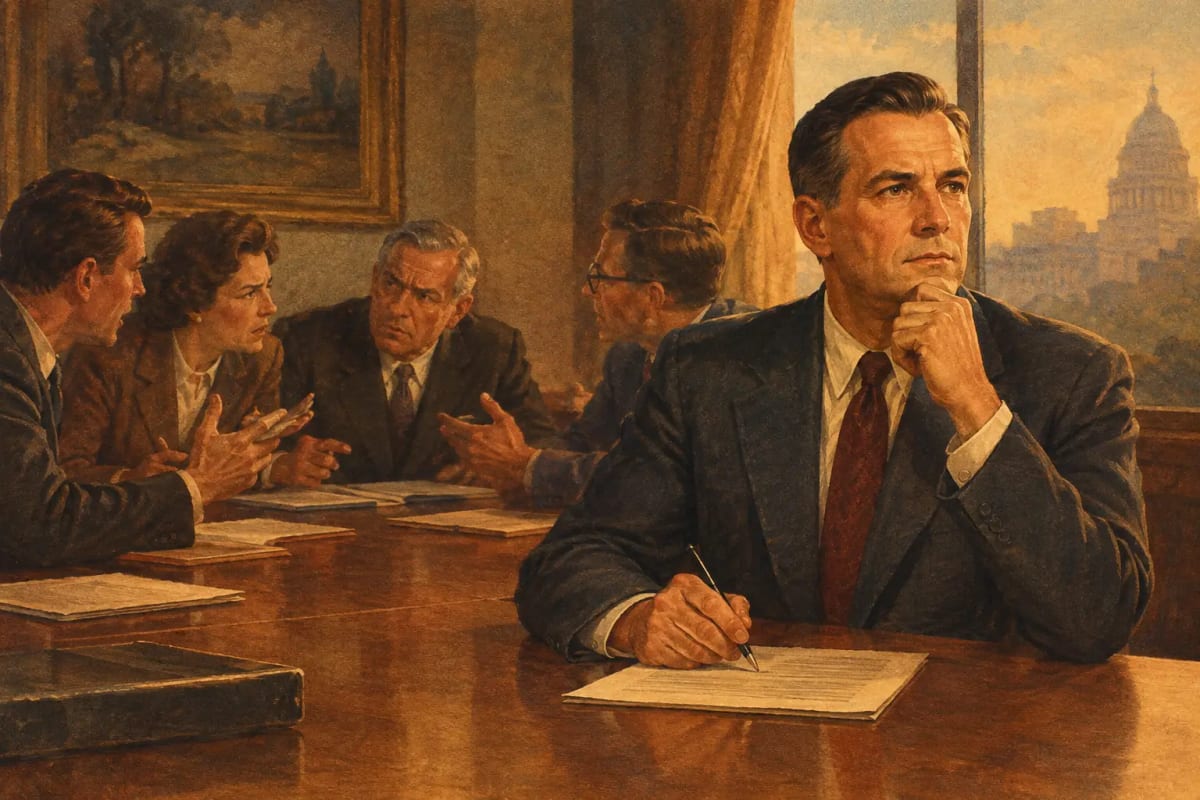
A boardroom can remain calm long after the institution it governs has entered danger. Revenue may still be arriving. The legal team may still be reviewing. Senior staff may still be asking for more data. Yet the window for a clean decision is closing.
This is when consensus fails. Not because consultation is weak, but because the conditions required for good consensus have disappeared: shared facts, sufficient time, aligned incentives, and confidence that someone else will bear the cost of being wrong.
For a CEO, founder, president, or board chair, this is the dividing line between administration and leadership. Administration works through normal process. Leadership begins when normal process cannot produce an answer in time.
The crisis is the audit. It reveals whether an organization has standards strong enough to govern action when agreement cannot.
Why Consensus Breaks Under Pressure
Consensus is useful in stable conditions. It gathers distributed knowledge, creates buy-in, and reduces the risk of unilateral error. A leader who refuses input as a matter of temperament is not decisive. He is merely isolated.
But consensus becomes dangerous when it is treated as a moral requirement rather than a decision tool. In a real institutional crisis, people do not enter the room with equal exposure to the consequences. The chief financial officer sees liquidity. General counsel sees legal risk. The head of people sees morale and retention. The operating leader sees execution. Board members may see fiduciary exposure, public scrutiny, or the preservation of relationships built over decades.
Each perspective is necessary. None is sufficient.
As pressure rises, consensus often fails in predictable ways. People protect their domain. They ask for evidence that cannot arrive before the decision deadline. They confuse reversibility with harmlessness. They recommend delay because delay spreads responsibility across the group.
That last temptation deserves direct attention. A delayed decision can feel prudent because no one person appears to have imposed it. But delay is still a decision. It can consume cash, damage credibility, expose employees to preventable harm, or allow an ethical breach to become institutional practice.
Lincoln did not wait for a unanimous political class before treating union as a governing obligation. Marshall did not build postwar recovery around the comfort of every competing faction. Their circumstances were different from those of a modern executive, but the governing principle remains: entrusted power exists for action, not for the preservation of personal innocence.
When Consensus Fails, Identify the Actual Decision Right
The first task is not to ask, “How do we get everyone aligned?” The first task is to establish who has the authority and duty to decide.
Organizations often obscure this question. A decision may be formally assigned to the CEO but functionally controlled by a committee. A board may possess legal authority while management has the operational knowledge needed to act. A founder may retain informal veto power long after the organization has outgrown founder-led governance.
Ambiguity is manageable in ordinary times. Under pressure, it becomes a source of institutional paralysis.
Name the decision owner. Name the required advisers. Name the deadline. Name the threshold at which a recommendation becomes a decision. Then record it.
This is not bureaucratic theater. A clear decision right prevents two opposite failures: the executive who acts beyond legitimate authority, and the executive who hides behind process while the institution absorbs the damage.
Authority without accountability is arbitrary. Accountability without authority is a trap. A serious institution aligns the two before the next emergency arrives.
Consultation Is Not Permission
Senior leaders should seek dissent, especially from people with relevant expertise and the courage to disagree. But consultation is not permission. The leader’s obligation is to hear the strongest contrary case, not to wait until every contrary voice is satisfied.
A useful question is: What would a fair critic say we failed to consider? Put that answer in the record. Then decide.
The distinction matters because consensus can become a veto system for the most risk-averse participant. It rewards those who can identify possible downside without accepting responsibility for the cost of inaction.
Use a Standard Before You Use an Argument
When facts are incomplete, arguments multiply. The organization needs a prior standard that can govern competing claims.
That standard is not a values poster. “Integrity,” “excellence,” and “teamwork” do not tell a leader whether to terminate a high-performing executive who falsified reports, pause a profitable product that creates foreseeable harm, disclose an operational failure before every fact is known, or reject a financing arrangement that compromises control.
A governing standard does.
An honor code translates aspiration into constraints. It states what the leader and institution will not do, even when pressure makes the shortcut attractive. It defines obligations to employees, customers, owners, communities, and the future institution. Most importantly, it establishes which duties prevail when those obligations conflict.
A workable standard should answer three questions:
- What are we entrusted to protect?
- What actions are prohibited, even if they reduce immediate pain?
- What cost are we prepared to bear to remain legitimate?
The third question is where character becomes operational. Every institution claims principles when principles are inexpensive. The test arrives when honesty threatens valuation, when fairness creates delay, or when discipline costs a favored executive their position.
Cato’s example is useful not because modern leaders should imitate Roman politics, but because he understood that public duty is not proven by private intention. It is proven by conduct under conditions where compromise would be easier and personally safer.
Build a Decision Record That Can Survive Scrutiny
A hard call should leave a record. Not a self-protective memo written after the outcome is known, but a contemporaneous account of the decision as it was made.
The record should state the facts known at the time, the material uncertainties, the options considered, the dissent heard, the governing standard applied, the decision owner, and the review trigger. Keep it plain. If a decision cannot be explained without evasive language, the institution may already know it cannot defend the decision.
This practice serves more than legal protection. It disciplines thinking. It forces executives to distinguish fact from assumption, principle from preference, and unavoidable harm from convenient harm.
It also protects successors. Institutions decay when each crisis becomes a private drama, understood only by those present in the room. A decision record turns judgment into institutional memory. It allows later leaders and boards to ask whether the organization followed its own standards, where it failed, and what must change.
The record is not a claim of certainty. It is evidence of stewardship.
Make the Call, Then Govern the Consequences
A decision made without consensus is not complete when it is announced. The leader must govern its consequences.
That begins with candor. People can accept hard news more readily than manipulation. Explain what was decided, what duty required it, what uncertainty remains, and what will be reviewed. Do not pretend the choice was painless if it was not. False reassurance converts a difficult decision into a trust failure.
Then establish a review point. Some decisions must be firm, particularly where ethics, safety, or institutional boundaries are concerned. Others should be revisited when specified facts change. The discipline is to define those conditions before the outcome pressures the organization to rewrite its rationale.
Finally, absorb the portion of the cost that belongs to leadership. Do not ask frontline employees to carry sacrifices while senior leaders preserve every privilege. Do not blame advisers for a decision you had the authority to make. Power held in trust requires visible ownership.
The Discipline to Build Before the Next Crisis
No executive can improvise a governing code at the precise moment fear enters the room. By then, incentives are distorted, loyalties are strained, and language becomes evasive.
The work must be done in advance. Leaders should identify their default failure mode under pressure: avoidance, domination, appeasement, abstraction, or impulsive action. They should write the standards that constrain that mode, test those standards against credible scenarios, clarify decision rights, and practice producing records before the stakes are existential.
This is the purpose of disciplined leadership practice. It turns moral claims into artifacts: an honor code, a decision memo, a culture standard, a succession record, and a command structure that does not depend on one person’s mood or charisma.
There will be moments when a leader should slow down, seek more counsel, and refuse the false urgency of a manufactured crisis. There will also be moments when delay becomes its own form of abandonment. Wisdom lies in recognizing the difference.
When agreement cannot be obtained, the question is no longer whether everyone will approve. The question is whether you can state the duty, make the hard call before pressure makes it, and leave behind a record worthy of the power you were given.
Fourth Turning Leadership Guide for CEOs
A Fourth Turning leadership guide for CEOs who must make defensible decisions, build durable institutions, and act before consensus arrives under pressure.
Organizational Decision Rights Guide for CEOs
This organizational decision rights guide helps CEOs assign authority, document escalation, and preserve institutional legitimacy under pressure in crisis.