Part of: Crisis Leadership
Crisis Command Versus Collaborative Leadership
In this dispatch
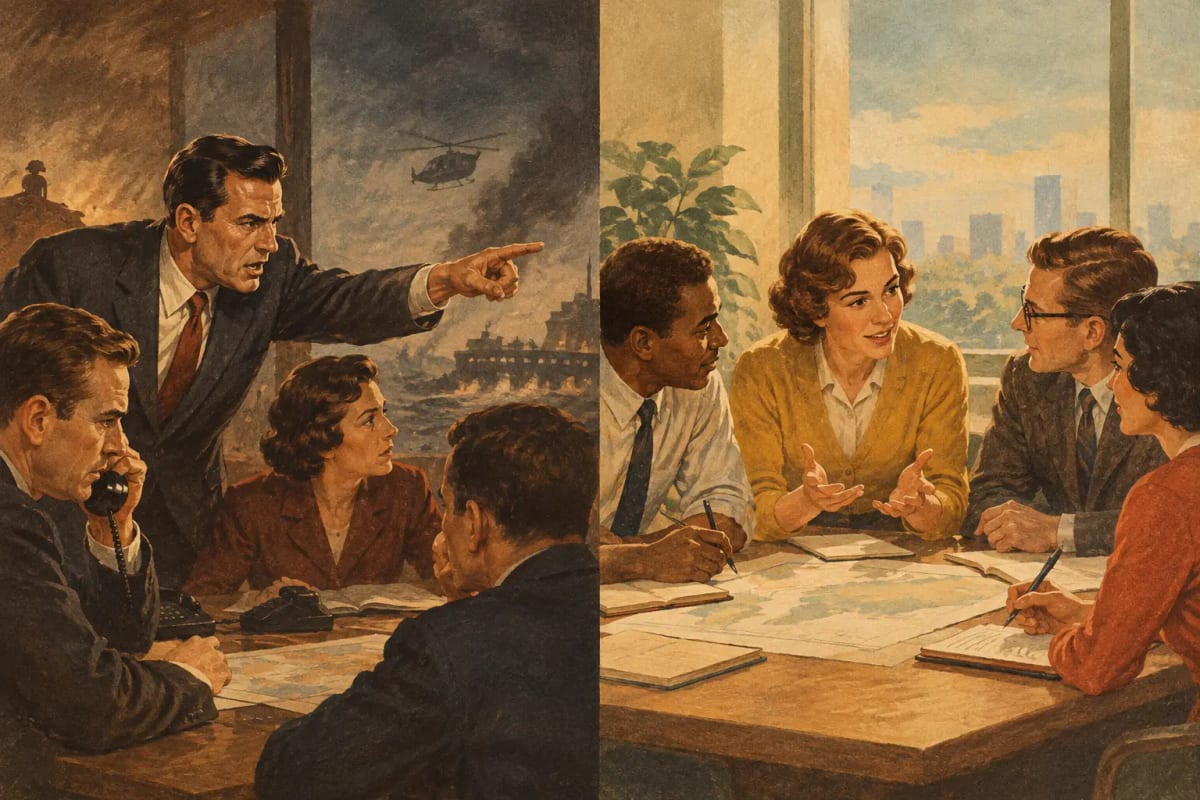
A bank loses liquidity over a weekend. A product failure puts customers at risk. A board discovers that a trusted executive concealed material facts. In these moments, the debate over crisis command versus collaborative leadership stops being theoretical. The leader must decide who has authority, what information is sufficient, and how long the institution can afford to wait.
The wrong answer is rarely simple weakness or simple arrogance. More often, it is a category error. Leaders use the habits that served them in stable conditions when the conditions have already changed. They seek broad agreement when speed is the duty. Or they centralize power after the immediate danger has passed, treating capable officers as spectators and calling it strength.
Crisis is the audit. It reveals whether authority was held in trust or merely accumulated.
Crisis Command Versus Collaborative Leadership Is Not a Choice of Personality
Command and collaboration are operating modes. Neither is a moral identity. A leader who prefers discussion may need to issue an order. A forceful founder may need to submit a decision to structured dissent before acting. The question is not, “Which style reflects me?” It is, “What does this situation require to protect the institution, its people, and its legitimacy?”
Crisis command is appropriate when delay materially increases harm, when responsibilities are clear, and when the leader has enough verified information to make a bounded decision. Its purpose is to establish direction under conditions where dispersed debate would produce confusion, leakage, or fatal delay.
Collaborative leadership is appropriate when the problem is complex rather than immediate, when facts are incomplete, when execution depends on voluntary commitment across functions, or when the decision will establish a precedent that others must carry for years. Its purpose is not comfort. It is to improve judgment, expose blind spots, and secure disciplined ownership.
The distinction matters because organizations often confuse urgency with emergency. A demanding quarter is not necessarily a crisis. A loud stakeholder is not necessarily a threat to institutional survival. If every decision becomes command, leaders exhaust their people, suppress warnings, and train the organization to wait for permission. If every decision becomes collaboration, leaders make consensus a substitute for judgment and leave the institution undefended when the hard call arrives.
The Test Is Time, Stakes, and Reversibility
Before choosing a mode, assess the decision on three grounds: time, stakes, and reversibility.
Time asks whether the window for action is actually closing. In a cyberattack, a safety incident, or a fast-moving liquidity event, the first obligation may be containment. There is no honor in convening a broad working group while the damage expands. Command sets the perimeter: stop the transfer, isolate the system, suspend the operation, preserve the records, appoint a single accountable lead.
Stakes ask what is being placed at risk. Decisions affecting life, fiduciary duty, public trust, legal compliance, or institutional continuity carry a burden that cannot be delegated into vague process. The CEO and board may seek counsel widely. They cannot outsource responsibility for the final judgment.
Reversibility asks whether an error can be corrected without permanent loss. A reversible pilot can bear more collaboration and experimentation. An irreversible decision, such as closing a plant, violating a covenant, making a public accusation, or dismissing a successor, requires a higher standard of evidence and a clear decision record.
These tests may point in different directions. A decision can be urgent and irreversible. In that case, command may be necessary for immediate containment, followed by a rapid, disciplined review before longer-term commitments are made. This is where mature leaders separate the first move from the whole decision. They do not confuse acting now with deciding everything now.
What Command Requires Beyond Decisiveness
Command without discipline becomes impulse with a title. The institution needs more than a leader willing to act. It needs a command structure that makes action legible and accountable.
First, name the decision owner. A crisis cannot be managed through a fog of overlapping authority. The owner may gather facts and assign work, but everyone must know whose judgment governs the next move.
Second, define the objective in plain language. “Protect liquidity for the next 72 hours” is an objective. “Get control of this situation” is not. A clear objective prevents staff from mistaking activity for progress.
Third, establish a reporting rhythm and a record. What was known? What was assumed? What was decided? What threshold triggers escalation? A written decision memo is not bureaucratic decoration. It is evidence that power was exercised with care. It also gives the institution a means to learn after the pressure recedes.
Fourth, state the limits of the order. Command should be bounded by purpose, time, and authority. If a CEO directs an emergency hiring freeze, the order should specify its duration, exceptions, review date, and owner. Temporary powers that lack an expiration date tend to become habits.
George Marshall understood that command rests on preparation, standards, and the development of subordinate leaders. The strongest commander is not the person who makes every decision personally. It is the person whose organization can act coherently when information is partial and the leader is not in the room.
Collaboration Must Be Designed, Not Romanticized
Collaboration is often presented as an ethical good in itself. It is not. Undisciplined collaboration can reward the loudest participant, conceal accountability, and turn a difficult decision into an endless search for emotional cover.
Useful collaboration has a defined question, a defined group, and a defined end point. Ask people to challenge assumptions, identify second-order consequences, and surface interests that may be invisible from the executive suite. Do not ask them to reenact a referendum on whether leadership has the right to decide.
The best collaborative sessions create productive dissent before the decision, then unified execution after it. A chief financial officer may see covenant risk that an operator overlooks. A general counsel may identify exposure in a seemingly efficient response. A frontline leader may recognize that a policy will fail because it ignores actual work. Those contributions are not obstacles to authority. They are part of responsible authority.
But the leader must distinguish dissent from diffusion. Once the relevant views are heard and the decision threshold is met, someone has to close the question. Organizations lose confidence when executives repeatedly reopen settled matters because they cannot tolerate the moral weight of finality.
The Failure Modes Are Predictable
Command has a destructive shadow: control for its own sake. Leaders in this mode can begin to treat questions as disloyalty, bad news as insubordination, and independent judgment as a threat. The result is an institution that looks orderly until it meets a fact no one is willing to report.
Collaboration has its own shadow: consensus-driven delay. Leaders may use inclusion language to avoid conflict, postpone accountability, or secure broad emotional agreement before taking a necessary action. The result is often polite deterioration. Everyone participated. No one led.
Both failures damage legitimacy. Employees, investors, customers, and citizens do not demand perfection from institutions. They do expect candor, consistency, and evidence that decisions were made for the institution rather than for the leader’s convenience.
This is why an honor code belongs at the center of leadership practice. Under pressure, values that have not been written, tested, and translated into decision rules become decorative. A leader who has already stated what cannot be traded away has a firmer basis for command and a clearer boundary for collaboration.
Build a Decision System Before You Need One
The time to define emergency authority is not during the emergency. Executive teams should establish decision rights, escalation triggers, communication protocols, and documentation standards while conditions are still stable enough for honest disagreement.
A practical exercise is to take three plausible scenarios - a liquidity shock, a major misconduct allegation, and a critical operational failure - and ask the same questions. Who can act in the first hour? Who must be informed? What facts require verification? What decisions are temporary? What must be documented for the board, regulators, employees, or future leaders?
The answers expose hidden ambiguity. They also reveal whether the organization has confused hierarchy with readiness. A title chart does not tell people how to act when legal, financial, reputational, and human pressures arrive at once.
The Fourth Turning Leader treats this work as a practice of documented judgment. A decision record, a tested honor code, and a clear command protocol do not remove uncertainty. They prevent uncertainty from becoming an excuse for drift.
When pressure comes, do not ask whether you are naturally a commander or a collaborator. Ask what the institution requires, make the hard call before pressure makes it for you, and leave a record worthy of the authority you were given.
7 Best CEO Decision Practices Under Pressure
Best CEO decision practices for leaders who must act under pressure, protect legitimacy, and leave records that withstand scrutiny after crisis arrives.
Crisis Governance Versus Risk Management
Crisis governance versus risk management: learn why boards must govern through disruption, not merely measure threats, controls, and exposure in crisis.