Part of: Crisis Leadership
Crisis Governance Versus Risk Management
In this dispatch
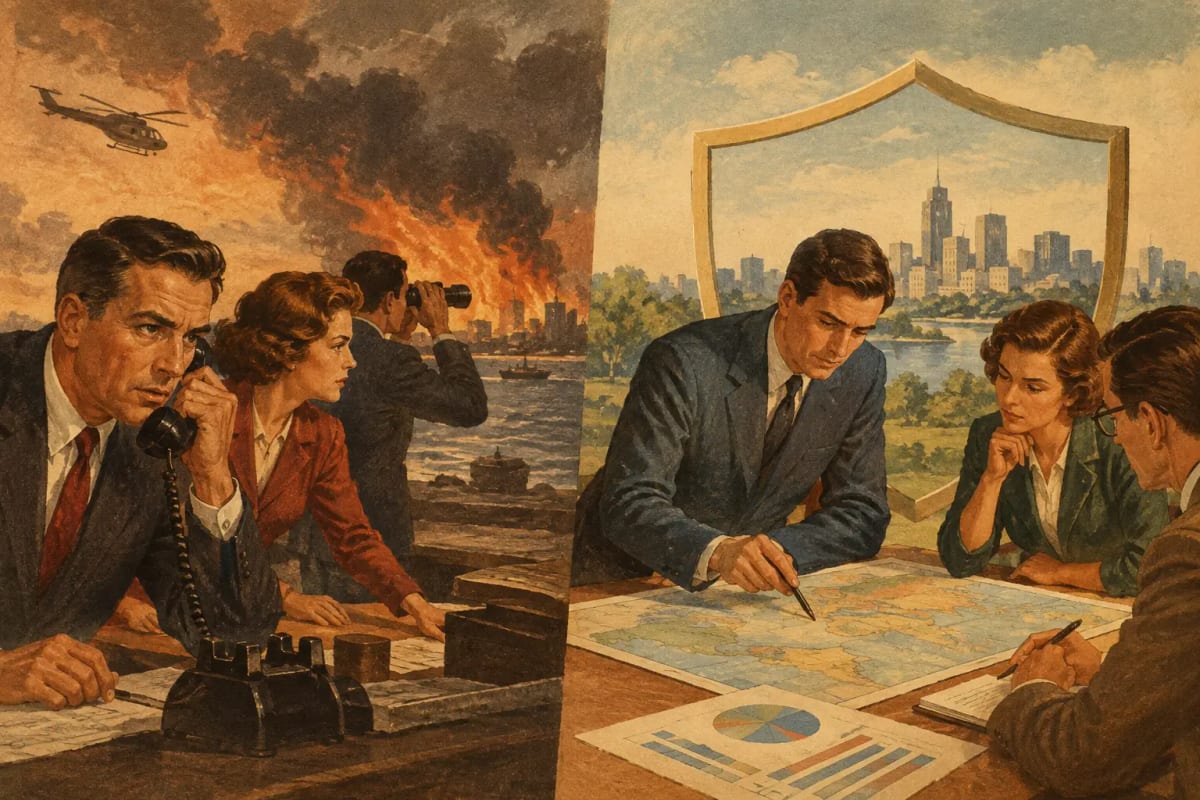
A lender discovers a liquidity gap on Friday afternoon. A university faces public allegations against a senior official. A manufacturer learns that a key supplier has concealed a safety defect. In each case, risk management may have identified warning signs. Crisis governance versus risk management becomes decisive when the question shifts from what could happen to who has authority, what standard governs the response, and what record will remain when the pressure passes.
Risk management is necessary. It is not sufficient. It catalogs exposures, assigns controls, measures likelihood, and prepares mitigation plans. Crisis governance determines whether an institution can act when its normal machinery is too slow, its incentives are divided, and its legitimacy is at stake.
The distinction matters because crises do not merely test operations. They audit power held in trust.
Crisis Governance Versus Risk Management: The Core Difference
Risk management is principally anticipatory. It asks where the organization is vulnerable and what safeguards can reduce loss. Its tools are familiar: risk registers, scenario analyses, insurance, compliance controls, thresholds, internal audits, and business continuity plans. Good risk leaders convert uncertainty into a disciplined field of attention.
Crisis governance begins when uncertainty becomes a consequential event, or when leaders must make decisions before facts are complete. Its concern is not only exposure. It is authority under strain. Who can decide? What principles limit that decision? How will conflicting duties be weighed? What must be disclosed, preserved, investigated, or stopped? Who bears responsibility if the decision fails?
A risk register can show that cyberattack probability is rising. It cannot, by itself, tell a CEO whether to shut down a revenue-producing system, notify customers before every technical fact is known, suspend an executive whose conduct is under investigation, or reject political pressure that would compromise an inquiry.
Those are governance judgments. They require more than data. They require an operating code.
Risk Management Protects the Enterprise
At its best, risk management protects the enterprise from foreseeable harm. It creates visibility where complacency would otherwise prevail. It insists that management quantify financial concentration, supplier dependency, regulatory exposure, talent gaps, data vulnerability, and operational fragility.
This work should be integrated into ordinary management. A board needs clear reporting thresholds. Executives need named owners for material risks. Control failures need escalation paths. Scenario planning should be specific enough to reveal where a plan rests on a false assumption, such as the availability of credit, a functioning communications channel, or public confidence in a regulator.
Yet risk management carries a recurring danger: it can create the appearance of command without command itself. A color-coded dashboard may reassure directors while masking an unaddressed question of duty. The organization has measured the threat, but no one has decided what they will refuse to do when threatened.
That is not a criticism of risk officers. It is a warning to boards and chief executives. They cannot delegate the moral and institutional burden of a crisis to the function charged with measuring exposure.
Crisis Governance Preserves Legitimate Authority
Crisis governance exists to preserve legitimate authority while making hard decisions at speed. It establishes the decision rights, ethical boundaries, records, and succession arrangements that allow an institution to move without becoming arbitrary.
The central question is not, Can we survive this? It is, What must we do to remain worthy of survival?
That distinction may sound severe. It is severe. A company can protect quarterly cash flow by withholding material information, scapegoating a subordinate, or quietly shifting losses onto customers. A university can protect headlines by treating due process as a public relations inconvenience. A board can preserve temporary calm by avoiding a necessary succession decision. Each action may reduce immediate risk. Each can destroy the authority required to govern later.
Crisis governance sets limits before expedience becomes policy. It identifies the non-negotiables: truthful records, proper process, protection of people who report wrongdoing, defined authority for emergency action, and accountability for those who exercise it. The standard should not depend on whether the press is watching or whether the decision is popular.
Lincoln understood that emergency authority required a durable account of its use. George Marshall understood that institutions require standards stronger than the personalities occupying office. Their examples are not ornaments. They point to a practical truth: leaders must make decisions that can withstand later scrutiny by those who did not share the fear of the moment.
Why Plans Fail Under Pressure
Most crisis plans fail at the point where human incentives take over. People protect turf. Counsel narrows the issue to liability. Communications teams seek language that sounds reassuring. Directors hesitate to challenge the executive who has delivered results. Managers wait for consensus because no one wants ownership of the hard call.
This is where governance either exists or does not.
A useful crisis structure makes several matters explicit before an event occurs. It defines who has emergency authority and where that authority ends. It states which decisions require board notice or approval. It creates an independent path for investigations involving senior leaders. It establishes how facts are logged, how dissent is recorded, and how temporary measures are reviewed or revoked.
These are not bureaucratic details. They are the difference between decisive action and improvised power.
Consider a CEO confronting credible allegations of financial misconduct by a top-performing division president. Risk management may flag litigation, revenue disruption, employee attrition, and regulatory exposure. Crisis governance asks whether the accused executive can influence the investigation, whether the board has independent information, whether preservation obligations have begun, and whether the company can explain its process without compromising fairness.
The right action depends on the facts. Immediate termination is not always the disciplined choice. Neither is delay. What matters is that the institution follows a defined standard, creates a defensible record, and prevents personal loyalty from substituting for judgment.
Build a Governance System Before the Event
A serious institution should treat crisis governance as a practiced discipline, not a binder retrieved after damage is visible. The work begins with a candid diagnosis of how the leadership team behaves under pressure. Does it become punitive, evasive, impulsive, legalistic, or frozen? Every leadership strength has a destructive shadow. Resolve can become recklessness. Prudence can become delay. Loyalty can become concealment.
From there, leaders need written instruments, not broad values statements. An honor code should state the duties the institution will uphold when those duties become costly. A crisis decision memo should identify the facts known, facts unknown, authority invoked, options rejected, obligations at stake, and review date. A legitimacy record should preserve the reasoning behind decisions that affect people, capital, and public trust.
These records serve two purposes. They discipline judgment in the moment, and they allow later review without manufactured memory. In a real crisis, memory becomes partisan quickly. Contemporaneous records restore proportion.
Drills are equally necessary. Do not rehearse only technical recovery. Put the board and executive team through situations where legal, financial, cultural, and reputational duties collide. Ask whether a CEO can act if the chair is unavailable. Ask what happens when the general counsel is conflicted. Ask who communicates with employees when public statements must wait. Ask whether the successor knows the governing standard or merely the org chart.
The Fourth Turning Leader treats this as document-based practice: a code, a decision record, a culture architecture, and a tested chain of command. The point is not to make leaders theatrical in a crisis. It is to make them less captive to panic, vanity, and institutional drift.
The Board's Distinct Duty
Boards often receive risk reports. Far fewer govern the conditions under which crisis decisions will be made. That is a category error with costly consequences.
The board should not attempt to run every emergency. Its duty is to establish the mandate, challenge false confidence, ensure independent channels of information, and hold management to a standard that survives beyond the incident. Directors must know when management can act alone, when the board must be convened, and when an outside investigation or special committee is required.
This requires a different kind of board conversation. Instead of asking only whether a risk has an owner, ask whether the institution has a principled response if that risk materializes. Instead of asking whether a policy exists, ask whether leaders have practiced applying it when incentives conflict. Instead of accepting an assurance that the matter is contained, ask what evidence supports that claim and who would have reason to withhold contrary evidence.
Such questions can feel uncomfortable. They should. Governance is not designed to make responsible people comfortable. It is designed to prevent comfort from becoming blindness.
Make the Hard Call Before Pressure Makes It
Risk management gives leaders the map of possible danger. Crisis governance tells them how to exercise authority when the map is no longer enough. One reduces uncertainty where it can. The other orders judgment where uncertainty remains.
A mature institution needs both. Without risk management, it is careless. Without crisis governance, it is unprepared for the moment when procedures, incentives, and public trust collide.
Write the standard while there is time to think. Name the authority. Rehearse the conflict. Keep the record. When the crisis arrives, do not ask what will make the discomfort disappear. Ask what decision your institution can defend after the pressure has lifted.
A Governance Documentation Guide for CEOs
This governance documentation guide shows CEOs how to build decision records, authority, and review routines that hold when pressure tests the institution.
How to Write Leadership Principles Under Pressure
Write leadership principles under pressure that guide hard calls, protect institutional trust, and create records built to survive public scrutiny intact.