Part of: Crisis Leadership
Crisis Leadership Framework for CEOs in Crisis
In this dispatch
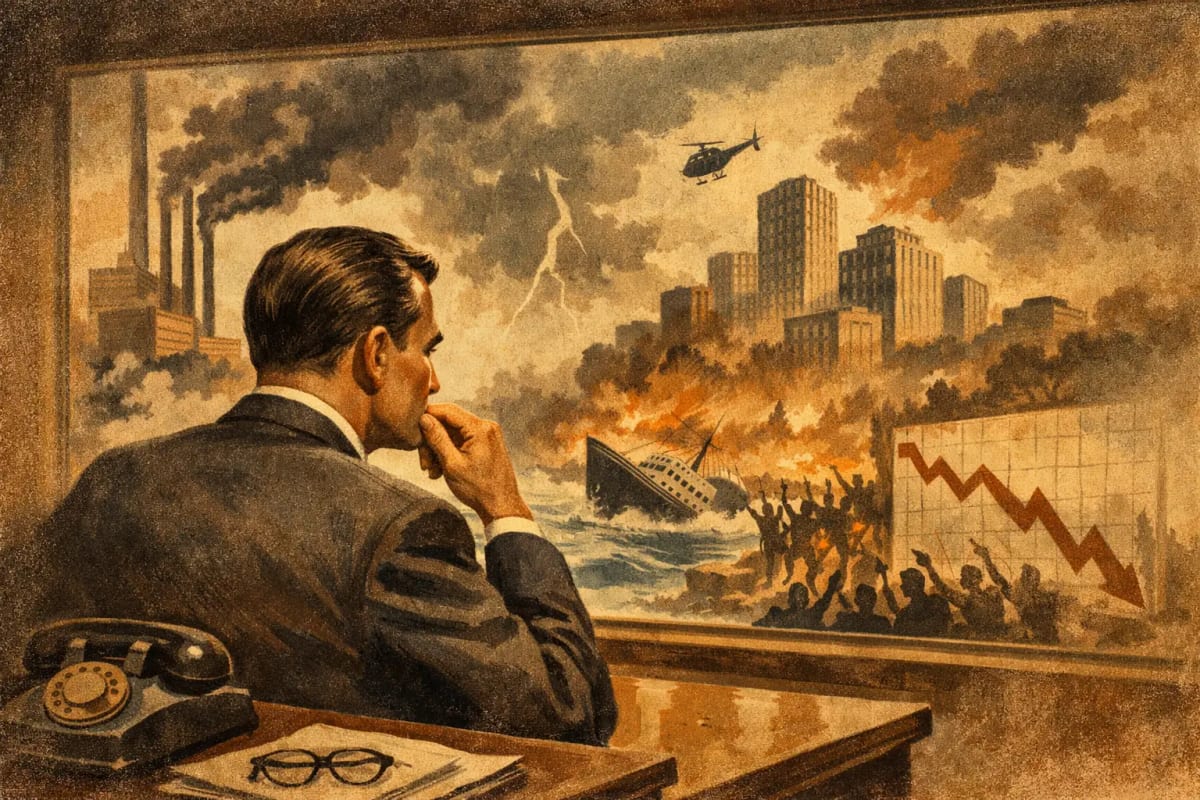
This executive briefing focuses on the decisions a CEO must make when a crisis reaches the leadership team: establish the standard, assign authority, and preserve the reasons for the call. For the complete method and historical examples, read the crisis leadership guide. For a usable record, start with the executive decision log template.
A crisis does not begin when the press calls. It begins when the operating assumptions beneath a company, institution, or market stop holding. Cash becomes uncertain. A trusted executive withholds the full truth. A regulator changes the terms. Customers lose confidence faster than forecasts can be revised. In that moment, a crisis leadership framework for CEOs is not a communications plan. It is a discipline for exercising power held in trust.
The first failure is usually not a bad decision. It is delay disguised as prudence. Senior teams wait for complete facts, board alignment, legal certainty, or public permission. But in a Fourth Turning environment, old systems fail before a new consensus forms. The CEO must often act while evidence is incomplete and every available path carries a cost.
The question is not whether a decision will create pain. It is whether the institution can explain, defend, and sustain the pain it chooses.
A Crisis Leadership Framework for CEOs Starts With Diagnosis
No leader enters pressure as a blank slate. Crisis reveals a default mode: the instinct to control, protect, deliberate, appease, withdraw, or charge ahead. Each mode has a strength. Each carries a destructive shadow.
The controlling leader can establish order but may suppress bad news. The deliberative leader can see complexity but may let the window for action close. The protective leader can preserve people and culture but may defend practices that are no longer defensible. The forceful leader can move an organization decisively but may confuse speed with judgment.
This is why diagnosis must precede command. Before issuing orders, a CEO should name three conditions plainly: what has failed, what remains true, and what must be protected at all costs. These are not slogans. They are operating facts.
If a lender has withdrawn support, the failure may be a financing assumption, not the mission. If a senior leader committed misconduct, the failure may be an accountability system, not merely one person. If a public controversy has damaged trust, what remains true may be the quality of the underlying work, while what must be protected is the institution's legitimacy to continue doing it.
A leader who misdiagnoses the problem will apply force in the wrong place. Cost-cutting cannot repair a credibility failure. A public statement cannot cure a cash crisis. A personnel change cannot substitute for a broken governance structure.
Establish the Non-Negotiable Standard
Every serious crisis creates pressure to make an exception. Hide the loss until the next quarter. Retain the high-performing executive despite the evidence. Shift blame to a subordinate. Promise a result the organization cannot deliver. Use legal defensibility as a substitute for moral responsibility.
The CEO's first task is to establish the line that will not be crossed. This is the practical use of an honor code. It turns admired values into a standard for decisions when incentives point elsewhere.
A usable standard is specific enough to constrain conduct. “We value integrity” is not enough. “We will not knowingly conceal material risk from those who bear it” is a standard. “We will protect the dignity of employees while making necessary reductions” is a standard. “We will not use public trust to buy time for private indecision” is a standard.
The trade-off is real. A public disclosure can accelerate short-term damage. Removing a powerful executive can destabilize a key division. Refusing a questionable transaction can strain liquidity. Yet crisis leadership is not the art of avoiding loss. It is the duty to choose losses that do not corrupt the institution's future.
Make the Hard Call Before Pressure Makes It
Once the standard is clear, the CEO needs a decision sequence that prevents panic, theater, and committee drift. The sequence should be fixed enough to use under stress.
First, define the decision in one sentence. Do not let the room debate five problems at once. “Do we disclose the breach before the investigation is complete?” is a decision. “What should we do about this situation?” is evasion.
Second, identify who bears the consequences. Include employees, customers, lenders, shareholders, communities, and future leaders. The loudest stakeholder is not always the one carrying the greatest risk.
Third, state the governing principle and the viable options. A decision without alternatives is often a preference masquerading as necessity. A decision with twelve alternatives is usually an attempt to avoid responsibility. Three paths are generally enough: act now, defer with explicit conditions, or refuse.
Fourth, name the irreversibilities. What cannot be recovered after this choice? Trust, liquidity, legal standing, a key relationship, a workforce, or the ability to claim that the organization acted honorably. Irreversible losses deserve disproportionate weight.
Finally, assign a decision owner, a deadline, and a review trigger. “We will revisit this” is not a plan. State what new fact would cause reconsideration and when it will be reviewed.
Speed matters, but haste is not strength. A CEO should move quickly when delay increases irreversible harm. A CEO should slow down when action would create a permanent moral, legal, or institutional breach. The discipline is knowing which condition is present.
Build a Record That Can Survive Scrutiny
The crisis is the audit. Years later, stakeholders may not remember every operational detail, but they will ask what the leadership knew, when it knew it, what standard guided the choice, and whether the record matches the public story.
That makes documented decision practice central to command. For consequential decisions, create a short decision memo that records the facts available at the time, the uncertainties, the alternatives considered, the chosen action, the responsible owner, and the standard applied. This is not bureaucratic self-protection. It is institutional memory and a restraint on revisionism.
The record should also distinguish fact from inference. In crisis, executives routinely overstate what they know because confidence is expected of them. False certainty damages credibility inside the organization and outside it. Say what is known, what is believed, and what remains unresolved.
A written record also improves board governance. Boards cannot fulfill their duty through vague updates and retrospective approval. They need to see the decision frame, the assumptions, the exposures, and the points where management requires a governing judgment rather than another discussion.
Command the Culture, Not Just the Incident
A CEO can resolve the immediate event and still lose the institution if the internal culture learns the wrong lesson. Staff watch who is protected, whose warnings were ignored, whether bad news travels upward, and whether standards apply to revenue producers as well as everyone else.
After the first action, establish a small set of observable expectations. Require escalation of material risks. Protect employees who report facts in good faith. Stop side-channel decision-making. Clarify who speaks externally. Remove incentives that reward concealment, reckless growth, or compliance theater.
This is where many leaders make the mistake of issuing broad cultural language when they need architecture. Culture is shaped by hiring criteria, authority lines, meeting rules, promotion decisions, incentive design, incident reviews, and succession expectations. If the structure rewards the behavior that caused the crisis, the apology is only a pause before recurrence.
The CEO must also decide what to communicate before every fact is settled. Silence can be disciplined when disclosure would compromise an investigation, violate privacy, or mislead through premature claims. But silence becomes cowardice when people who carry material risk are left to discover the truth elsewhere. Explain the boundary. State what can be said now, what cannot, and when the next update will come.
Preserve Legitimacy Beyond the Quarter
Legitimacy is not public relations. It is the accumulated belief that an institution deserves the authority it holds. It is earned when leaders accept accountability proportionate to their power.
This may require a CEO to forgo the most convenient option. A founder may need to relinquish a role. A board may need an independent review. A company may need to compensate people it could legally leave behind. A university may need to admit that a process was compromised before it can restore confidence in the result.
There is no formula that removes judgment. The right action depends on the facts, the institution's duties, and the scale of the harm. But the test remains consistent: does this choice preserve the organization's capacity to govern itself honorably after the emergency passes?
The strongest leaders do not wait for calm to discover their code. They write it, test it against hard scenarios, and make it visible in the records their institutions keep. When pressure arrives, do not search for courage in the moment. Put the standard on paper now, assign the next decision owner, and make the hard call before pressure makes it for you.
How to Build Clear Board Escalation Protocols
Learn how to build board escalation protocols that clarify authority, trigger fast action, preserve records, and protect legitimacy when action cannot wait.
Leader Mode Assessment Guide for Hard Calls
This leader mode assessment guide helps CEOs identify their default under pressure, confront its shadow, and build decision records that hold scrutiny.