Part of: The Leadership Honor Code
What Is a Leadership Honor Code? (And Why Every CEO Needs One Before the Next Hard Call)
Part of the Leadership Honor Code cluster
In this dispatch
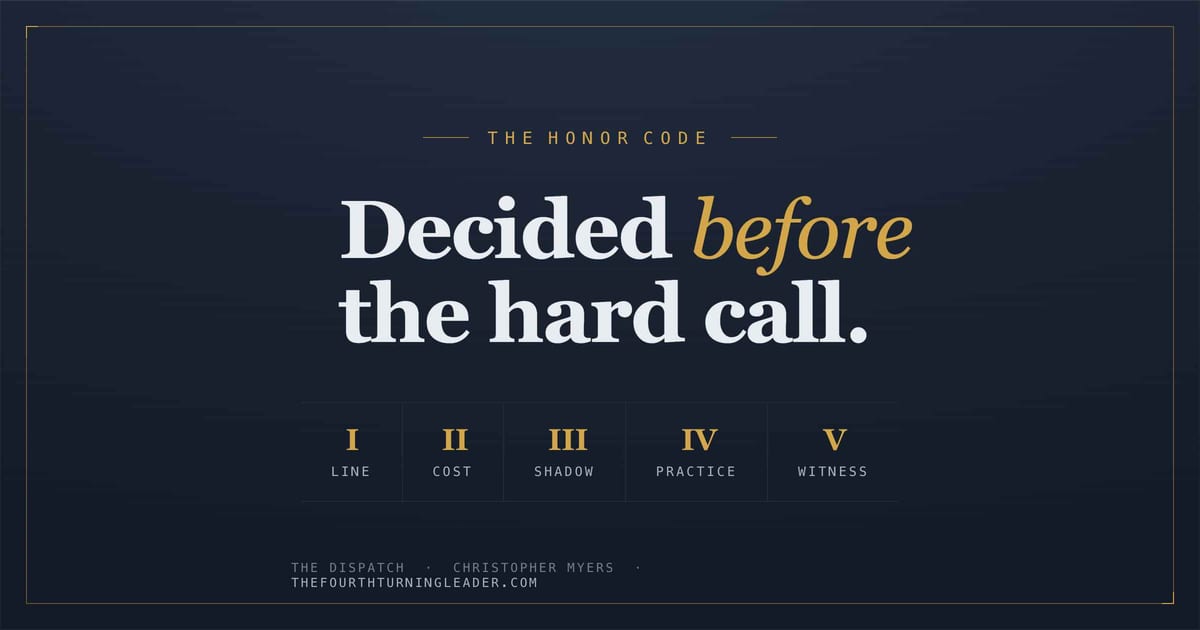
A leadership honor code is a set of decisions you have already made, written, specific, and tested against your actual shadow, that you can return to when stress starts negotiating with you.
That is the definition. Everything else in this article is what it looks like in practice, why most leaders don't have one, and what it costs them when the pressure arrives before the code does.
The Problem With the Meeting That Changes Everything
Most CEOs can identify the moment it happened. Not the decision itself, the setup.
The board meeting where the room had already decided before you walked in. The investor call where "we're excited about your direction" translated, somewhere in the second hour, into a set of expectations you didn't agree to but also didn't refuse. The regulator conversation that left you feeling like the terms of your company's legitimacy had just shifted without anyone saying it out loud.
In each of those moments, there was a decision available to you. A line you could have held, a refusal you could have made, a question you could have asked that would have changed the outcome. You knew it was there. But the pressure of the room, the relationships at stake, the capital at risk, the institutional weight of the moment, moved faster than your clarity.
That gap between what you know and what you do under pressure is exactly what a leadership honor code closes.
It closes it not by making you braver in the moment, but by removing the decision from the moment entirely. The code is written before the pressure arrives. When the room narrows, you are not deciding who you are. You already did that. You are returning to it.
Why Values Statements Fail
A values statement is a description of who you intend to be. An honor code is a commitment about what you will do when being that person costs something.
These are not the same thing.
Most organizations have values. They are posted in the office, repeated at offsites, and listed in employee handbooks. "Integrity." "Courage." "Accountability." The words are real. The problem is that a word, even a good word, does not resolve a decision when the decision has a cost attached to it.
The board is pressuring you to replace your CFO not because she is underperforming, but because she asked the question that slowed down the deal. You believe in "integrity." Does that belief tell you what to do? Does it hold when the investor calling for her departure controls your next raise?
A value without a specific, written commitment attached to it is not an operating instrument. It is a self-description. Self-descriptions are tested by pressure and frequently fail it, not because the leader is a bad person, but because the description was never specific enough to guide a decision at cost.
An honor code is different because it is specific. It names behaviors, not virtues. It identifies the actual decisions: "I will not remove a team member under investor pressure unless there is documented performance cause", not the principle behind them. And it names the cost those decisions will carry, in advance, so that the leader who encounters the cost is not surprised by it and does not mistake surprise for a new consideration that justifies backing down.
What an Honor Code Actually Contains
A functional leadership honor code has five components. Each one is a different kind of prior decision.
The Line. What cannot be traded? This is the non-negotiable, the specific behavior, decision, or refusal that you have decided in advance represents a limit you will not cross regardless of the pressure applied. It is written as a specific statement, not a general principle. Not "I value integrity" but "I will not misrepresent our financial position to our lenders, regardless of what that disclosure costs us in the short term."
The Cost. What will the line require when it matters? A line without its cost attached is aspirational, not operational. The cost is what makes the commitment real: writing it forces the leader to acknowledge that holding the line will be expensive, and to decide, in advance, that the expense is acceptable. A leader who is surprised by the cost of their code when pressure arrives is a leader whose code will not hold.
The Shadow. Where are you most likely to rationalize erosion? Every leader has a specific failure mode, a pattern of reasoning they return to when the pressure is on and the code is expensive. "It's just this once." "The situation is genuinely different this time." "I'm doing it to protect the team." The shadow is the argument you will make to yourself at the exact moment the code needs to hold. Naming it in advance removes its power.
The Practice. What behavior will keep the code alive between decisions? An honor code that only exists at the moment of crisis is a code that will not be accessible at the moment of crisis. A practice is a regular discipline, a weekly written reflection, a monthly review of the code against recent decisions, a question you ask before every high-stakes call, that keeps the commitments active rather than archival.
The Witness. Who has standing to tell you when you are drifting? A code without a witness is a private commitment that can be privately revised. The witness is someone, a trusted colleague, a board member, an advisor, who has been explicitly told they have permission to name the drift when they see it. Their standing is granted before the pressure, not after.
The Pre-Commitment Mechanism
The behavioral architecture behind the honor code is pre-commitment, a concept with a substantial evidence base in decision science. The core finding: making a decision in advance, under conditions of lower stress and lower cost, produces a different choice than making the same decision in the moment, under full pressure.
This is not a character weakness. It is a structural feature of how judgment works under cost. The leader who writes "I will not remove a team member for asking hard questions" when there is no current investor pressure is a different decision-maker than the leader who faces that question cold during a board call with $8 million on the line. The first decision is made with full access to the leader's values. The second is made with those values under active competition from fear, loyalty, and self-preservation.
The honor code does not make the leader braver. It transfers the decision to a version of the leader who had better access to what they actually believe.
Three Historical Modes of Holding the Code
The honor code is not a modern management concept. The question of how to maintain a written commitment under pressure when the cost of maintaining it is real has been addressed by every serious tradition of leadership ethics in recorded history.
Cato the Younger wrote his refusals down before Julius Caesar arrived. His code was unconditional enough that when the alternative to compliance was suicide, he chose suicide. That is an extreme; it is not a model for modern executives. But what Cato understood is that a code held only when convenient is not a code, it is a preference.
Washington, at Newburgh in 1783, walked into a room full of officers who had already decided to march on Congress. He had the code: civilian authority over military force. He held it. The cost was the room's contempt for what looked like weakness in the moment. He held it anyway because he had decided the line in advance, and the room's contempt was part of the cost he had already acknowledged.
Seneca, Nero's advisor, operated in a more complicated mode. He knew his patron was deteriorating. He kept writing. He kept the private ledger of what he actually believed, the Letters from a Stoic, composed over the years when he could not say publicly what he knew privately. The code did not keep him clean; it kept him honest about what he was compromising and why, which is a different kind of integrity than Cato's but no less real.
Each of these represents a different mode of holding a code under cost. The mode that fits your pressure is one of the things the Five Modes Framework is designed to help you identify.
What the Code Is Not
An honor code is not a values statement for your organization. The code is personal, specific to the leader, and built around the leader's actual failure patterns, not the team's aspirational culture.
It is not a personality test result. It is not what your MBTI or Enneagram says about you. Personality frameworks describe tendencies; an honor code commits to specific decisions at specific costs.
It is not a guarantee. A leader with a written honor code will still face moments of drift. The code does not eliminate the pressure; it creates a named reference point to return to when the pressure has been applied. The difference between a leader who drifts and one who holds is often not character, it is whether there is something written to return to.
It is not finished. An honor code is reviewed after every hard decision. What you discover about your shadow in the meeting room is data. The code is a living document, updated as the leader learns more about where the actual lines are and where the actual costs fall.
Building Yours
If you have never written a leadership honor code, the place to start is not with your strengths. It is with your history of pressure.
Where have you made decisions you regretted, not because you lacked information, but because the room was moving faster than your clarity? Where have you told yourself a story about why the exception was justified, and later recognized the story as a rationalization? Where has your specific shadow, your particular form of "just this once", cost you something you didn't want to pay?
Those are the entry points. Name the line you wish you had held. Name the cost you would have paid to hold it. Name the argument you made to yourself that let you step over it. Write those three things down.
That is the beginning of a code.
The Honor Code Builder inside the Leader Lab walks through the full five-part sequence, the line, the cost, the shadow, the practice, the witness, with structured prompts designed to surface the specific rather than the aspirational. The Mode Finder assessment can help identify which pressure type you are currently navigating, which affects which part of the code needs the most attention right now.
If you want the longer architecture, what goes into the code and why, how to test it against realistic pressure scenarios, the resource page on building a leadership honor code walks through the full build sequence.
The meeting that changes everything is coming. It may be in the next quarter. It may be this week. The pressure will arrive at the speed that pressure always arrives, faster than the room expects and faster than general principles can absorb.
The code needs to exist before that meeting. Not for the pressure you anticipate. For the one you don't.
Build the code before pressure writes one for you.
Christopher Myers is CEO of B:Side Capital, entrepreneurship faculty at ASU W.P. Carey School of Business, Founder and Chairman of Main & Machine, and author of Honor Under Pressure. This article feeds the Leadership Honor Code pillar. Related resources: What Is an Honor Code for Leaders? · How to Build a Leadership Honor Code · The Five Modes Framework
- The code works by removing the decision from the moment.It is written before the pressure arrives, so when the room narrows you are not deciding who you are. You already did that. You are returning to it.
- A values statement is not an honor code.A values statement describes who you intend to be. An honor code commits to what you will do when being that person costs something.
- A functional honor code has five components.The Line, the Cost, the Shadow, the Practice, and the Witness. Each one is a different kind of prior decision, naming behaviors rather than virtues.
- The mechanism is pre-commitment.Deciding in advance, under lower stress and lower cost, produces a different choice than deciding in the moment under full pressure.
- The code is a living document, never finished.It is reviewed after every hard decision. What you discover about your shadow in the meeting room is data, and the code is updated as you learn where the lines actually fall.
Frequently asked
What is a leadership honor code?
A leadership honor code is a set of decisions you have already made, written, specific, and tested against your actual shadow, that you can return to when stress starts negotiating with you. It closes the gap between what you know and what you do under pressure by removing the decision from the moment.
What is the difference between a values statement and an honor code?
A values statement describes who you intend to be. An honor code commits to what you will do when being that person costs something. A value without a specific, written commitment is a self-description, not an operating instrument, and self-descriptions frequently fail under pressure.
What does a leadership honor code contain?
It contains five components, each a different kind of prior decision. The Line names what cannot be traded. The Cost names what holding the line will require. The Shadow names where you rationalize erosion. The Practice keeps the code alive between decisions. The Witness has standing to name your drift.
Why do honor codes work under pressure?
They work through pre-commitment. Making a decision in advance, under lower stress and lower cost, produces a different choice than making it in the moment under full pressure. The code does not make you braver. It transfers the decision to a version of you with better access to what you actually believe.
How do you write a leadership honor code?
Start with your history of pressure, not your strengths. Find the decisions you regretted because the room moved faster than your clarity. Name the line you wish you had held, the cost you would have paid to hold it, and the argument that let you step over it. Write those three things down.