Part of: Crisis Leadership
How Should CEOs Lead in a Crisis? Make the Hard Call
In this dispatch
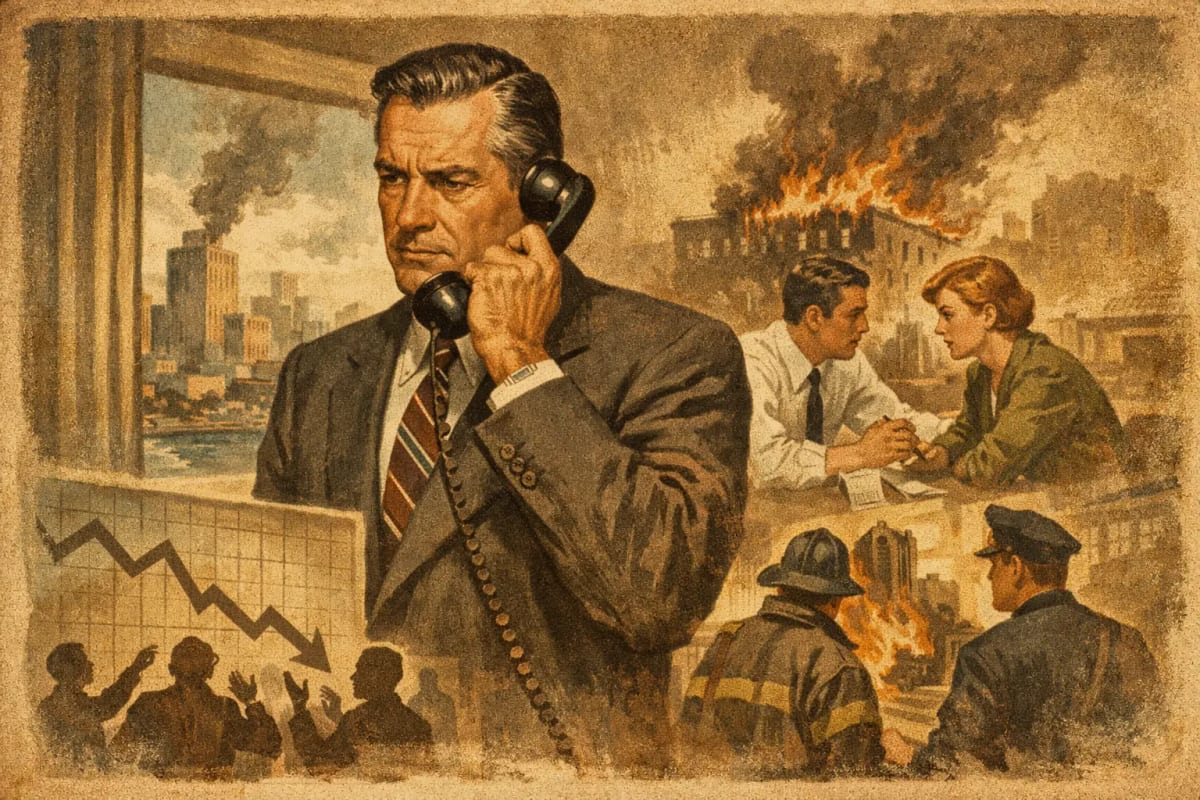
A crisis does not first test a CEO’s communications plan. It tests whether the leader can distinguish fear from fact, urgency from panic, and duty from self-protection. How should CEOs lead in a crisis? By treating power as held in trust, establishing the standard before the pressure peaks, and making decisions they are prepared to defend when the room is no longer friendly.
The crisis is the audit. Employees watch whether stated values hold when payroll, reputation, market access, legal exposure, and personal standing are at risk. Boards watch whether management can see clearly. Customers and communities watch whether the institution becomes smaller in character precisely when its consequences become larger.
A CEO cannot remove uncertainty. The job is to impose moral and operational order on it.
How Should CEOs Lead in a Crisis? Start With a Governing Code
Most executive failures do not begin with bad intentions. They begin with an unexamined default. Under pressure, one CEO delays until consensus appears. Another centralizes every decision and exhausts the organization. Another protects the quarterly number while silently spending institutional trust. Another makes a dramatic public promise that operations cannot honor.
A governing code gives the leader a fixed point before those instincts take command. It is not a values poster. It is a short set of commitments that defines what the institution will protect, what it will not do, and who has authority to act when normal processes fail.
The code must be specific enough to constrain behavior. “We value integrity” is not a standard. “We will not conceal material operational risk from the board, customers, or regulators, even when disclosure creates short-term cost” is a standard. “We will protect the safety and lawful dignity of employees before executive convenience” is a standard.
This does not make every decision easy. It makes the basis for decision visible. In a real crisis, a CEO may need to choose between preserving cash and preserving headcount, between public transparency and a legitimate legal constraint, or between a rapid intervention and a deliberative process. A code does not erase the trade-off. It prevents expedience from disguising itself as principle.
Establish a Small Command Structure
A crisis organization needs fewer meetings, clearer authority, and a disciplined record. Do not confuse broad consultation with distributed command. Input should travel widely; decision rights should not.
Name the crisis leader, the operational owner, the legal and risk authority, the communications authority, and the person responsible for maintaining the decision record. If one person holds multiple roles, say so plainly. Ambiguity creates delay, duplication, and private maneuvering at the exact moment the institution requires coherence.
The CEO remains accountable for the whole. That does not mean personally approving every action. It means setting thresholds: which decisions must come to the chief executive, which must reach the board, which may be executed by the incident team, and which facts trigger immediate escalation.
The difference matters. A CEO who insists on controlling everything becomes a bottleneck. A CEO who delegates without standards creates competing centers of power. Command is not personal dominance. It is ordered responsibility.
Build a decision record while facts are still moving
Every consequential decision should produce a brief written record. Capture the facts known at the time, the assumptions that remain unverified, the options considered, the governing principle, the decision owner, and the next review point.
This practice protects both speed and legitimacy. Speed improves because the team does not reopen settled questions without new evidence. Legitimacy improves because the organization can later show that it acted from a reasoned standard rather than impulse, favoritism, or concealment.
The record also disciplines the CEO. When leaders must write why they are taking an action, vague rationalizations become harder to sustain. The question is no longer, “Can we get away with this?” It becomes, “Will this reasoning stand if employees, directors, customers, and successors read it five years from now?”
Tell the Truth in Operational Terms
Crisis communication is not a performance of reassurance. It is an act of command. People need to know what happened, what it means for them, what the organization is doing, what remains unknown, and when they will hear again.
Do not manufacture certainty. False confidence may calm a room for an afternoon, but it turns into cynicism when the facts change. The stronger posture is controlled candor: “Here is what we know. Here is what we do not know. Here is the decision in force. Here is the next threshold at which we will revise it.”
That language is especially necessary when the news is bad. A layoff, a safety failure, a liquidity event, a cyber breach, or a public accusation cannot be made painless by better phrasing. The CEO’s duty is to make sure affected people are not treated as an afterthought to investor messaging or legal containment.
Legal counsel should shape what can responsibly be said. Counsel should not become an excuse for saying nothing meaningful. There are times when details must remain confidential. Even then, leaders can state the standard guiding the response, acknowledge the human stakes, and commit to a decision date or update cadence.
Protect the Institution, Not the Executive
The most dangerous temptation in a crisis is to turn the organization into a shield for the people at the top. This appears in small acts: withholding a report, blaming a subordinate, delaying a board notification, softening a known risk, or selecting an investigation designed to produce a comfortable answer.
The CEO must reverse that instinct. Protect the institution’s capacity to tell the truth, correct itself, and continue serving its obligations. That may require bringing in independent review, recusing an interested executive, informing the board before the story is fully convenient, or accepting a near-term loss to avoid a lasting breach of trust.
There is a practical case for this as well as a moral one. Institutions recover from bad events more readily than from dishonesty about bad events. Capital can be replaced. Credibility is slower to rebuild, and sometimes cannot be rebuilt by the same leadership team.
This is where a board becomes more than a compliance body. A strong CEO gives directors the unvarnished picture early, names the decisions that require their judgment, and does not demand ceremonial loyalty. Directors, in turn, should ask whether management has a real command structure, a reliable fact base, and documented standards for the hard calls.
Act Before Consensus, Then Reassess
In institutional crisis, consensus often arrives after the decisive window has closed. The CEO must be willing to act on incomplete information when delay creates greater harm. But speed without review becomes recklessness.
Set decision intervals. For a rapidly moving operational event, review every few hours. For a financial or reputational event, perhaps daily. At each interval, ask what has changed, which assumptions failed, whether the current action still serves the governing code, and whether a new threshold has been crossed.
This is the discipline behind the phrase: make the hard call before pressure makes it. Early action may look excessive to those who cannot yet see the full risk. Later, it may prove insufficient. The CEO’s task is not to achieve the appearance of perfect foresight. It is to show sound judgment, timely correction, and fidelity to duty as conditions change.
The Fourth Turning Leader treats this as a practice, not a personality trait. Leaders diagnose the default mode that emerges under pressure, write an honor code, test it against real scenarios, and leave behind decisions that can be audited. That work is best done before the emergency meeting, not during it.
Leave the Organization Stronger in Its Standards
A crisis ends operationally before it ends institutionally. Systems must be repaired, customers restored, losses understood, and people given a credible account of what happened. The after-action review should not become a search for a scapegoat or a congratulatory narrative. It should identify where authority was unclear, where information failed to travel, where incentives distorted judgment, and where the code was ignored or proved inadequate.
Then change the architecture. Update escalation rules. Train successors. Revise decision thresholds. Remove incentives that reward concealment. Keep the record intact, including the uncomfortable parts.
The final measure of a CEO is not whether the crisis was flattering. Few are. It is whether the institution emerged with its core obligations intact and its people able to say that, under pressure, their leaders did not abandon the standard. Build that proof now, while there is still time to choose it.
How to Write Leadership Principles Under Pressure
Write leadership principles under pressure that guide hard calls, protect institutional trust, and create records built to survive public scrutiny intact.
Board Decisions During a Crisis Must Hold
Board decisions during a crisis require more than speed. Set authority, test facts, record dissent, and protect legitimacy when public pressure is highest.