Part of: The Fourth Turning, Explained
What Is the Fourth Turning? A Leader's Test
In this dispatch
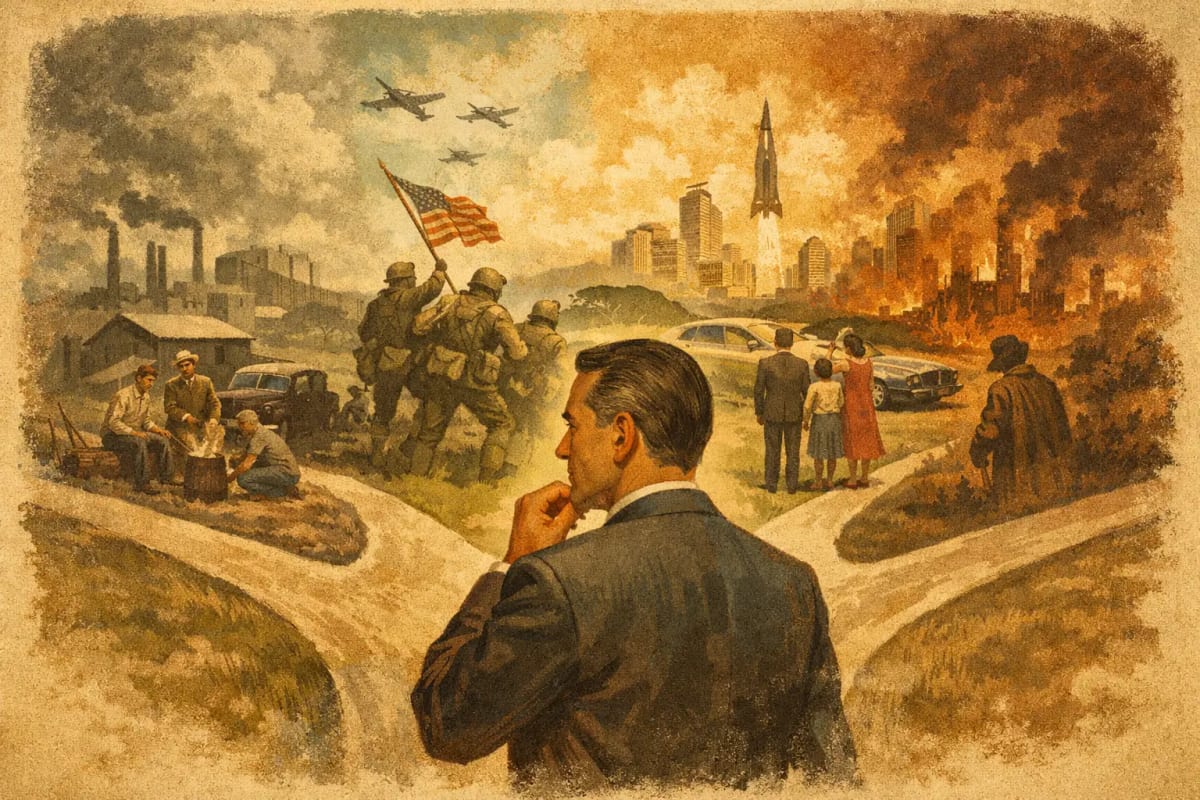
This essay examines what the Fourth Turning lens asks of a leader today. For the theory’s origins, generational cycle and limitations, start with Fourth Turning explained. For the practical method, read Fourth Turning leadership.
A board can approve the right strategy and still fail the moment that matters. A lender can preserve liquidity while losing public trust. A CEO can protect quarterly results by postponing a necessary conflict until the conflict owns the company. That is the terrain behind the question, what is the Fourth Turning? It is not a prediction that excuses passivity. It is a framework for recognizing when institutional routines no longer carry the weight placed upon them.
For leaders entrusted with capital, people, and legitimacy, the practical question is harder: What do you do when the old rules remain on paper but no longer command belief? The answer begins with history, but it ends in decisions.
What Is the Fourth Turning?
The Fourth Turning is the crisis phase in a generational-cycle theory developed by William Strauss and Neil Howe. Their theory argues that American history tends to move through recurring social eras, or "turnings," each lasting roughly a generation. Over a long cycle called a saeculum, the country moves from institutional confidence to cultural awakening, fragmentation, and eventually a period of crisis that forces a new public order.
The fourth phase is the Fourth Turning. It is marked by institutional breakdown, heightened conflict, public distrust, financial strain, political realignment, and decisions that cannot be deferred. The old arrangement has lost legitimacy. Yet the replacement has not been secured.
This does not mean every emergency is a Fourth Turning. Companies face crises every year. Nations face shocks, scandals, wars, recessions, and social conflict without entering a full historical rupture. The concept describes a broader condition: a period when multiple systems fail at once and the public can no longer assume that established authorities will restore order.
In a Fourth Turning, the central problem is not merely volatility. It is legitimacy. Who has the right to decide? By what standard? Who bears the cost? And what record will remain when the pressure passes?
The Four Turnings in Brief
Strauss and Howe described four recurring eras. A High follows a successful crisis, when institutions are strong and collective confidence is high. An Awakening challenges those institutions in the name of conscience, identity, faith, or personal meaning. An Unraveling follows, as shared authority weakens and society becomes more fragmented. Then comes the Crisis, or Fourth Turning, when unresolved tensions demand a reckoning.
The pattern is often illustrated through American eras. The founding crisis and the Civil War are commonly treated as prior Fourth Turnings. The Great Depression and World War II form another. Each period involved more than hardship. Each forced questions of constitutional order, national purpose, economic responsibility, and sacrifice that ordinary politics could not settle.
That history gives the theory its force. It reminds leaders that institutions are not permanent simply because they are familiar. A bank, university, association, public agency, or family enterprise can retain its formal structure while losing the trust that makes the structure functional.
But history is not a clock. It does not repeat on schedule, and it does not grant anyone the authority to declare an inevitable outcome. The theory is most useful as a diagnostic lens, not a prophecy machine. It can sharpen attention to conditions that demand judgment. It cannot tell you which decision is honorable, lawful, or wise.
Why the Fourth Turning Matters to Leaders
During stable periods, leaders can often rely on precedent, process, and consensus. A policy can be delayed for another committee meeting. A cultural breach can be managed quietly. A succession problem can remain unnamed because the institution has enough surplus trust to absorb the ambiguity.
During a crisis period, that surplus disappears. Delayed decisions become decisions. Vague values become permission for the strongest faction to define them. A leader's private compromise becomes public evidence of what the institution actually serves.
This is why a Fourth Turning is an audit of leadership. It tests whether power was held in trust or merely occupied. It exposes the difference between an organization with a mission statement and one with a governing code.
The senior leader's work changes accordingly. The task is not to manufacture confidence through messaging. It is to establish standards that can survive scrutiny, make trade-offs visible, and leave a record that subordinates, boards, customers, and successors can examine.
Consider a company confronting a politically charged employee conflict, a cash shortfall, or a regulatory inquiry. There may be no option without cost. The hard question is not how to make the cost disappear. It is whether the organization can explain its choice in terms that are consistent, lawful, and worthy of its stated obligations.
A leader who says, "We had no choice," is often signaling that no governing standard was prepared before the pressure arrived. In a Fourth Turning environment, that failure compounds quickly.
The Danger of Treating Crisis as Theater
The Fourth Turning concept can be abused. It can encourage grandiosity, fatalism, or a taste for catastrophe. Some people use historical-cycle language to make every political disagreement feel civilizational. Others use it to avoid responsibility: if collapse is inevitable, why build, repair, or compromise?
That is the wrong use of the framework.
Crisis language does not make a leader serious. Seriousness is demonstrated through disciplined action. It means separating genuine institutional risk from noise. It means refusing to exploit fear for attention. It means recognizing that a crisis may require decisive action while still demanding due process, proportionality, and restraint.
There is also a practical trade-off. Speed matters when a threat is real, but speed without a standard becomes improvisation. Consensus can become cowardice, but consultation can reveal facts a single executive misses. The work is to know which is which before the moment of decision.
A useful test is simple: Can you state the principle behind your decision, name the harms it imposes, document the alternatives considered, and defend the result after the immediate pressure is gone? If not, the institution may be reacting rather than governing.
How to Lead When the Old System Is Failing
A crisis-era leader needs more than a point of view. He or she needs an operating discipline. Start by identifying the few obligations that cannot be traded away: fiduciary duty, human dignity, lawful conduct, mission integrity, or the safety of those placed in your care. These are not brand adjectives. They are boundaries on action.
Then turn those obligations into a written code. A code should answer difficult questions before the emergency: What will we protect? What will we not do, even under financial or political pressure? Who has authority to decide? What evidence must be recorded? When does the board intervene? What must be disclosed, and to whom?
Next, practice against scenarios that are unpleasant enough to reveal weakness. A culture is not proven by how people behave when incentives align. It is proven when a high performer violates a stated standard, when a donor or customer applies pressure, when layoffs are necessary, or when the leader's own interests conflict with the institution's duty.
Documentation matters here. Decision records are not bureaucratic debris. They are evidence of stewardship. They show that the organization considered facts, named conflicts, applied a standard, and accepted responsibility for the consequences. In a period of low trust, that discipline is part of legitimacy.
Finally, build for succession. Institutions often fail because their standards exist only in the personality of a founder or a celebrated executive. If the code cannot be taught, tested, and carried forward by others, it is not yet an institutional asset. It is personal preference with better language.
The Work Is Not to Predict the Crisis
The value of the Fourth Turning framework is not that it tells a CEO exactly what will happen next. No historical model can do that. Its value is that it refuses the comfortable assumption that stability will return before you have to act.
Leaders do not control the cycle, the headlines, or every source of pressure on their institutions. They do control whether they enter a hard season with standards already written, authority already clarified, and decisions already disciplined.
Make the hard call before pressure makes it for you. Then leave a record worthy of the people who must live with what you decide.
Stewardship Versus Ownership Under Pressure
Stewardship versus ownership shapes every high-stakes decision. Learn how leaders hold power in trust and preserve legitimacy under pressure in crisis.
How to Build Clear Board Escalation Protocols
Learn how to build board escalation protocols that clarify authority, trigger fast action, preserve records, and protect legitimacy when action cannot wait.