Part of: The Leadership Honor Code
The Cohn Doctrine
Part of the Leadership Honor Code cluster
In this dispatch
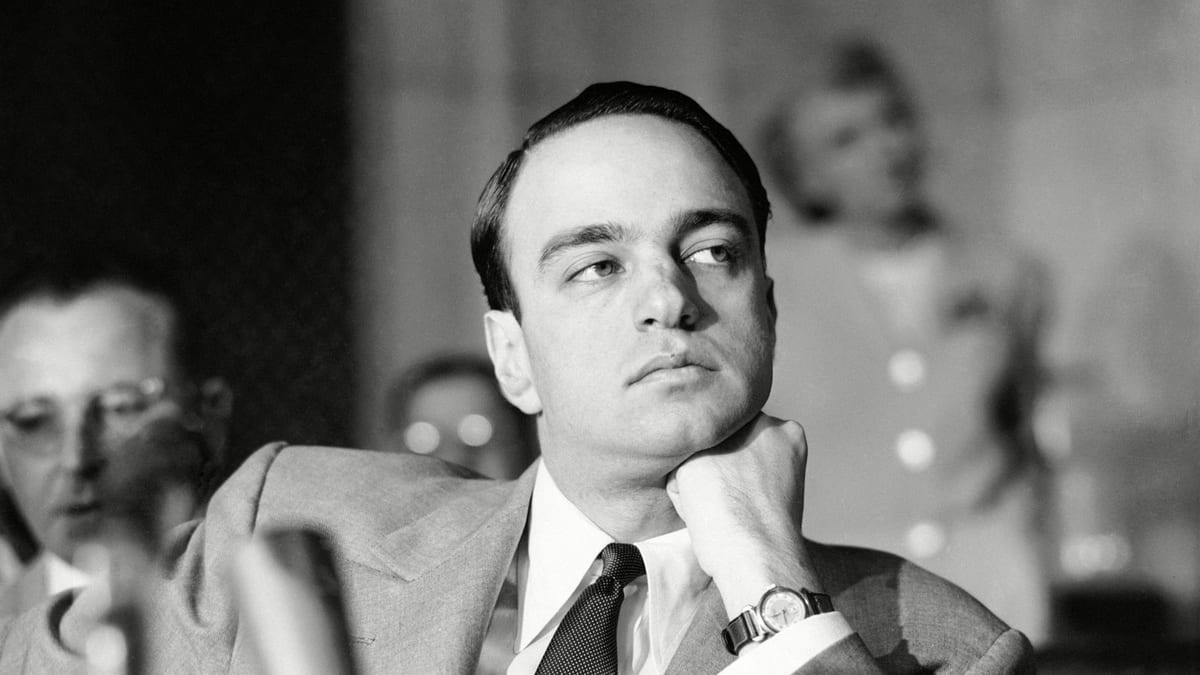
The Cohn doctrine is the win-at-all-costs code descended from fixer Roy Cohn, the exact inversion of an honor code: attack first and always, admit nothing and deny everything, and no matter what happens, claim victory and never admit defeat.
You have watched it win for ten years, and you have probably borrowed from it yourself, in a meeting, a negotiation, a moment you would rather forget. It wears on you and never hands you the words. Here they are.
Win at all costs. Take what you can and get out of the tight spots. Lie when lying helps and call it strategy. Stand for something, but only when it is cheap and asks nothing of you. Attack first and attack always, so the other man never gets his feet under him. Admit no mistake. Deny every charge. No matter what actually happened, claim victory and walk away as if you meant for it to go exactly this way. Collect fame, money, and power, because those are the only scores that count, and anyone keeping a different ledger is a mark waiting to be cleaned out.
You know this code. You have watched it run from Main Street to Wall Street to the Oval Office, and it raises a question honest people are now asking out loud. Is honor a relic? Is doing the right thing, the costly thing, the thing nobody will ever clap for, just a tax that suckers pay? Is honor for suckers?
I want to make the case that it is not, but not by pretending honor pays. It often does not. The argument only works if we start by admitting how strong the other side is.
The code has a name and a bloodline
This ethos did not fall from the sky. It has a genealogy, and naming it is most of the work.
It runs through Roy Cohn, Joseph McCarthy's chief counsel in the Red Scare years and later a New York fixer. Cohn distilled his philosophy into three rules quoted for decades. Attack, attack, attack. Admit nothing, deny everything. No matter what happens, always claim victory and never admit defeat. He passed it to a young Donald Trump, and from there it spread mentor to protégé, through business and politics, until it was in the water. Cohn's own motto tells you what kind of code it is. He did not ask what the law said. He asked who the judge was.
I call it the Cohn doctrine, and I do it deliberately. The point is not one man or one party but a code, complete and coherent, the exact inversion of an honor code. It has spread because it works in the short run, in every arena, and most of us have absorbed more of it than we would admit. The most powerful offices in the country run on it. So do plenty of unglamorous ones. Look at your own week and you will find your fingerprints on it.
A Crisis is when honor stops paying
A Fourth Turning is a Crisis era, precisely the season when honor stops paying in the visible ledger. And that is exactly when it counts.
The old institutions that rewarded decency and punished the predator are cracking, and the new ones have not set. In that gap, the man who keeps his word competes against men who treat theirs as a tactic, and for a while the liar wins. This is not a sign that honor is dead. It is the reason the question feels urgent now and felt quaint twenty years ago. When the structures that enforced the code fall away, do you keep it anyway, on your own authority, with no umpire and no scoreboard.
The High that follows a Crisis is constructed by the people who held the line while holding it cost them. Honor in a Crisis is a long bet, placed in the one season designed to make long bets look foolish.
Now give the cynic his due
So let me make the cynic's case for him, as well as he would.
In a world full of defectors, the cooperator does get exploited. That is not paranoia, it is arithmetic. The man who claims victory while lying often does collect the fame, the money, and the office. Doing the right thing frequently costs you and returns nothing you can see. The honest bidder loses the contract to the one who padded the numbers. The honest witness loses the job. The man who will not cut the corner watches the corner-cutter get the promotion and the parking spot and the corner office to match.
Any argument for honor that skips this is a greeting card, and the cynic stops reading at the first false note. My book is called Honor Under Pressure, not Honor Without Cost. The pressure is the price. We concede it in full, then argue for honor anyway, on four grounds.
One. Honor was never a strategy
Honor cannot be for suckers, because it was never a transaction in the first place.
The Stoics did not practice virtue because it paid. Marcus Aurelius, who held the most powerful office on earth, told himself to stop debating what a good man should be and simply be one. Seneca said the reward of a good deed is to have done it. That is not motivational gloss. It is a claim about where the ledger lives. The honorable man keeps his books inside himself, in the only account no rival can raid and no Crisis can freeze. Ask what honor pays and you have picked up the cynic's ledger and lost the thread of it. Honor is what you are when the scoreboard is switched off. A code you keep only when it is winning is not a code. It is a costume.
Two. The winnings are real, and they rot
He wins. The winnings are real. They are also hollow, and they corrode the man who collects them. Dostoevsky understood this better than any economist. The man who lies to win loses the ability to tell when he is lying, then the ability to know what is true at all, including about himself. He ends where every man who lies to win ends. Surrounded by people who fear him, fed flattery he cannot test, the sole audience for a show staged entirely for his benefit. He has traded every honest mirror for a hall of paid ones. He calls this winning. It is the loneliest condition a human being can purchase, and he paid full price.
Three. Even on the cynic's own ledger, he is wrong
The third answer beats the cynic on his own turf, worth doing once before we climb back up.
In 1980 the political scientist Robert Axelrod ran a tournament, pitting strategies against each other at the prisoner's dilemma over hundreds of rounds, with the smart money on something ruthless. The winner was the simplest entry, a program called Tit for Tat that cooperated first and then did to its opponent whatever the opponent had last done. It never struck first, punished betrayal at once, and forgave the moment the other side came back. The ruthless strategies cleaned up in the first round and starved after, because nobody who survived them would ever cooperate again.
The defector wins the round and loses the tournament. Trust is the load-bearing infrastructure of any economy and institution, the thing Charlie Munger spent his life pointing at. A civilization of defectors does not get rich. It gets poor and afraid. Every person who keeps the code when it costs him is repairing a commons the cynic is strip-mining. Honor is the seed corn, and the cynic eats it and calls the meal a victory.
Four. Honor under pressure has a face
The fourth answer shuts down the word sucker entirely. A sucker does not know the price; these people knew it exactly and paid it on purpose.
Cato the Younger chose to die at Utica rather than accept a pardon from Caesar, because taking the mercy would have blessed the tyranny. He lost. Caesar won the world. And Rome held Cato up for three hundred years as the measure of an honest man, which tells you which of the two the republic wanted its sons to become. George Marshall wanted command of the Normandy invasion more than anything, and when Roosevelt all but offered it, he refused to ask and let the President decide on the merits. The command went to Eisenhower. That is honor with a cost you can measure, and nobody died for it, which is why an ordinary person can use it on a Tuesday.
Then there is Franz Jägerstätter, an Austrian farmer who refused to swear the oath to Hitler and was beheaded in 1943. He was nobody. He expected no reward and got none in his lifetime, and was nearly forgotten before the Church beatified him more than sixty years later. Hold onto him, because the limits of the record are the whole argument. The honorable people we remember are the survivors of memory, the dramatic ones, the famous losses.
For every Cato and every Thomas More, who went to the block rather than swear to a lie, there were ten thousand quiet men who took the smaller paycheck, lost the promotion, kept the oath no one witnessed, and vanished without a line of record. Jägerstätter is the one who barely made it into the books. Treat him as the representative of the multitude who did not.
And it is not only history. A few years ago Elizabeth Holmes built Theranos on a lie, a blood machine that never worked, and ran the Cohn playbook to protect it, attacking her critics and denying everything to the end. Two of the people who brought her down were lab techs barely out of college, Tyler Shultz and Erika Cheung. Shultz was twenty-two, and the board member who had brought him in was his own grandfather, a former Secretary of State who told him to his face that he was wrong. His parents told him to let it go. He took the harder road, and for it he was tailed by private investigators, threatened with lawsuits he could not afford, and rattled badly enough that he slept for a while with a knife under his pillow. Cheung was terrified and wrote to the regulators anyway. Neither was thanked at the time, and both were proven right only years later, after the price had already been paid. The predator who tried to crush them is the one who ended in a cell. You do not have to reach back to Rome. You only have to decide which of them you intend to be.
They sold us a counterfeit of greatness and we bought it, mistaking the man who never loses a round for a strong one. He is the thing a hero stands against. A Crisis runs on the other kind, bold enough to act and selfless enough to pay for it, and every Fourth Turning is decided by how many of them it can produce. We are not short on winners. We are short on heroes.
The code that answers the doctrine
So we come back to the question. Is honor for suckers? Now we can answer it cleanly.
Honor is a set of fixed commitments you hold when holding them costs you something. That is the Honor Code, and it is not a feeling or a brand or a posture you adopt when the cameras are rolling. It is the standard you keep when the corner-cutter is winning and no one is watching and the visible ledger says you are a fool. The Cohn doctrine is the easier code. It will keep beating you in the short rounds. Hold the line anyway, because the long game and the inner ledger and the world built after this Crisis all run the other way, and because the man who trades his honor for a win has bought the one thing that was never worth the price.
Honor is not for suckers. It is for the people the next era gets built on. The sucker is the one who sold it, took the win, and never found out what it cost him until the hall of mirrors was the only company he had left.
- The Cohn doctrine is a named, coherent code, not random bad behavior.It traces through Roy Cohn to a young Donald Trump and spread mentor to protege through business and politics until it was in the water. Cohn asked not what the law said but who the judge was.
- A Crisis era is exactly when honor stops paying in the visible ledger.The old institutions that rewarded decency are cracking and the new ones have not set. In that gap the liar wins for a while, which is why the question feels urgent now.
- The defector wins the round and loses the tournament.In Axelrod's 1980 prisoner's dilemma tournament, the ruthless strategies cleaned up early and starved, while Tit for Tat, which cooperated first and forgave, won.
- Honor was never a transaction, so it cannot be for suckers.The Stoics did not practice virtue because it paid. The honorable man keeps his books inside himself, in the only account no rival can raid and no Crisis can freeze.
- The winner of the doctrine ends alone in a hall of mirrors.The man who lies to win loses the ability to tell when he is lying, then loses the truth entirely, and ends surrounded by people who fear him and flattery he cannot test.
Frequently asked
What are Roy Cohn's three rules?
Roy Cohn distilled his philosophy into three rules quoted for decades. Attack, attack, attack. Admit nothing, deny everything. No matter what happens, always claim victory and never admit defeat. He passed this code to a young Donald Trump, and it spread mentor to protege through business and politics.
Why is the Cohn doctrine called an inversion of an honor code?
It is a complete and coherent code that reverses honor point for point. Where honor holds fixed commitments that cost you, the doctrine wins at all costs, lies when lying helps, admits no mistake, and counts only fame, money, and power. The name marks the whole ethos, not one man.
Is honor for suckers?
No. Honor is a set of fixed commitments you hold when holding them costs you something. A sucker does not know the price, but honorable people know it exactly and pay it on purpose. Honor is for the people the next era gets built on, not for the one who sold it.
Why does honor stop paying during a Fourth Turning?
A Fourth Turning is a Crisis era, precisely the season when honor stops paying in the visible ledger. The institutions that rewarded decency are cracking and the replacements have not set, so for a while the liar wins. Honor in a Crisis is a long bet placed in the season built to make long bets look foolish.
How did Tit for Tat win Axelrod's tournament?
In 1980 Robert Axelrod pitted strategies at the prisoner's dilemma over hundreds of rounds. Tit for Tat, the simplest entry, cooperated first, then did whatever its opponent last did. It never struck first, punished betrayal at once, and forgave immediately. The ruthless strategies won early and starved after.
What Is a Leadership Honor Code? (And Why Every CEO Needs One Before the Next Hard Call)
A set of decisions you've already made, written, specific, and tested, so that stress can't renegotiate them when the hard call arrives.
The Only Thing That Still Scales
When institutions decay and the tools built for stability stop working, character becomes the rarest competitive advantage there is.